5 Strategies to Build a High-Performing Rental Sales Team
5 Strategies to Build a High-Performing Rental Sales Team
A great salesperson can grow revenue. A great sales system can scale a business. Here is the difference — and how to build it.
There is a moment that happens in rental sales environments that most managers have seen. Someone picks up the phone, the conversation goes sideways, and within thirty seconds frustration takes over. The rep slams down the receiver. Maybe walks it off. The sale is lost — and nobody learned anything. That moment is not a talent problem. It is what happens when a salesperson is left to figure it out on their own. No defined process, no objection framework, no training, no accountability, and no tools to fall back on when pressure arrives.
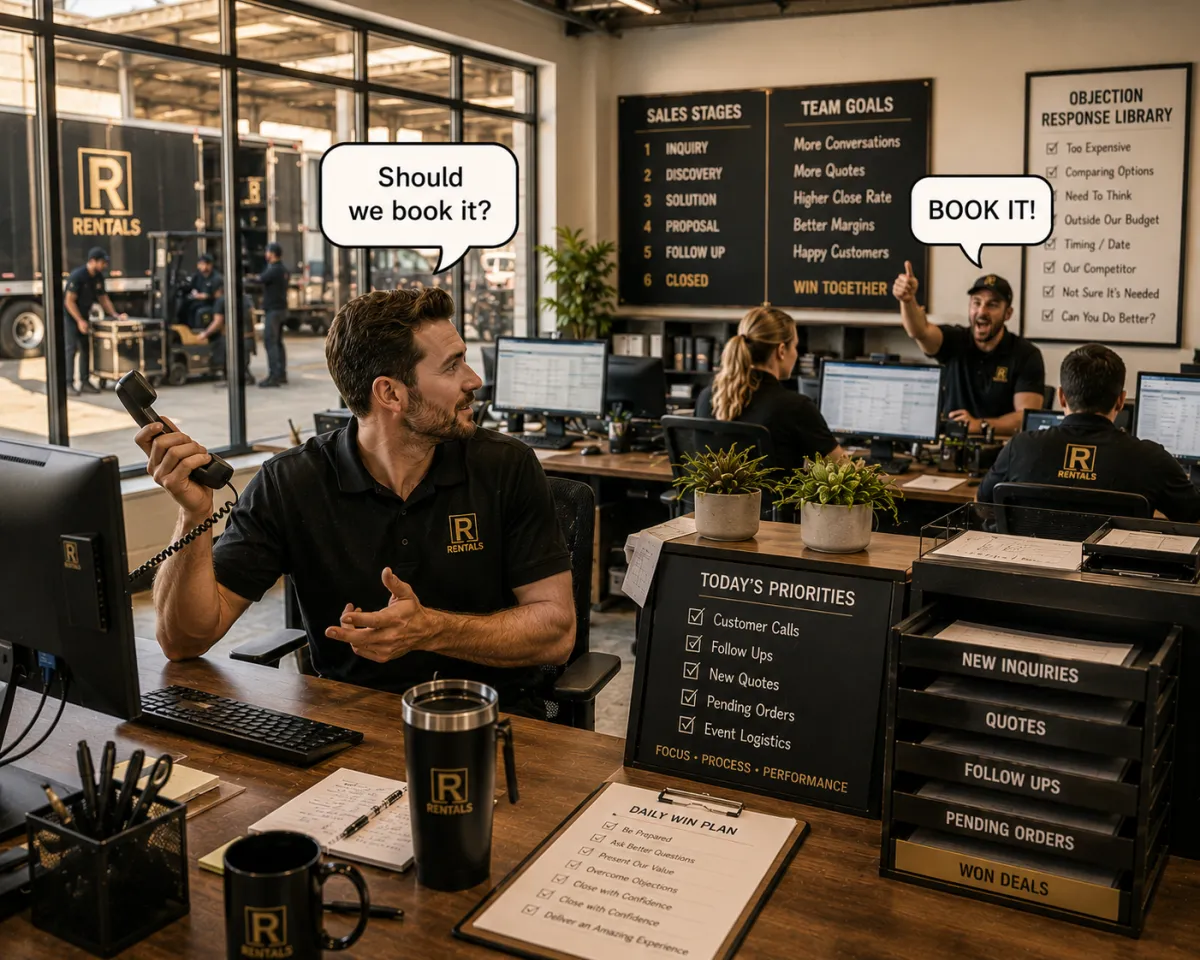
The opposite also exists. A team where someone mutes a call and says, "I have someone on the phone — they need this by tomorrow morning and will return it by noon in time for the 1:30 reservation. Should we do it?" And from across the room comes the answer: "Book it." That is not random energy. It is a team that knows exactly how to operate because the system underneath them is clear, trained, and trusted.
Building that kind of sales team in a rental business is not about finding exceptional people, though talent matters. It is about building a system that allows strong performers to excel and average performers to succeed consistently. Here is how.
01
Build a defined, repeatable sales system, not a collection of individual approaches
If your sales results depend on who picks up the phone, you do not have a sales system. You have a collection of individual styles producing unpredictable outcomes. When the top rep has a great month, revenue looks fine. When they leave, and eventually they do, customers often follow, methods disappear, and performance drops immediately. That is not a sales operation. That is a single point of failure dressed up as a sales team.
A sales system is a structured, repeatable process that turns customer conversations into consistent, measurable revenue. It does not remove personality or autonomy from your team. It creates consistency beneath individual characteristics so that every conversation is supported by the same foundation regardless of who is handling it.
At a minimum, your system should define the stages of every sales conversation, the discovery questions used to uncover real customer needs, how your value is articulated in response to what the customer is actually trying to accomplish, and what happens after the call ends. When those elements are documented, trained, and used consistently, coaching becomes specific, improvement compounds, and the business retains its sales knowledge even when individuals come and go.
→Conversation stages: defined steps for each type of sale from inquiry to close
→Discovery questions: designed to uncover the customer's real need, not just their stated request
→Value statements: clear, practiced articulation of what sets your business apart
→Offer pathways: upsells, downsells, and alternative solutions for every scenario
→Follow-up sequences: structured next steps for undecided, delayed, and inactive prospects
→Deal rules: discount limits, approval thresholds, and pricing boundaries everyone follows
02
Build an objection library and train your team on it regularly
Every rental sales team hears the same objections repeatedly. Your competitor is cheaper. We need to think about it. We are still comparing options. That is outside our budget. Yet most businesses still allow their reps to handle these moments differently every time, improvising responses based on instinct rather than drawing from tested, proven frameworks. That inconsistency is a direct and recoverable revenue leak.
The goal is to build a documented objection response library, which is a clear set of tested responses to the objections your team encounters most often. For each one, the library should capture what the customer is actually saying beneath the surface, because the first objection is rarely the real issue. "Too expensive" often means the customer does not yet see enough value, or is not aware of the risk lower-priced competitors carry. A strong response acknowledges the concern, reinforces the value, and redirects the conversation toward decision-making confidence all without ever saying "but," "unfortunately," or "however."
Example: "Your competitor is cheaper"
Weak response
Let me see if I can lower the price.
Strong response
I understand price is an important part of the decision. Most of our customers choose us because of the value within that price. We guarantee reliability, accuracy, and responsiveness. If we do not arrive within our delivery window, the delivery fee is free. And we hit that window 99.8% of the time.
That response acknowledges, pivots to value, and closes with a guarantee. The customer now has new information to process, which keeps the conversation moving rather than ending it. Build that library for your ten most common objections, train on it in weekly meetings, and watch your close rate improve without changing a single thing about your pricing.
03
Fix the operations problems your sales team is apologizing for
Many rental sales teams operate under pressure they should never have to carry. They spend calls apologizing for operational mistakes, compensating for unclear pricing, smoothing over preventable service failures, and recovering conversations that were damaged by inconsistency in delivery or follow-through. That is not a sales problem. It is a business systems problem that has been handed to the sales team to manage one conversation at a time.
If you want your sales team to sell a premium service, your operation has to deliver a premium service. Sales cannot sustainably convince customers of something that is not consistently true. When the operation delivers on what the sales team promises, the sales conversation becomes easier, cleaner, and more honest. At that point, the business does much of the selling. The rep's job shifts from convincing to guiding — and that is a far better position to be in.
Before investing in sales training or hiring additional reps, ask honestly where operations is creating friction that sales has to absorb. Strengthen those areas first. When alignment exists between what is sold and what is delivered, sales performance improves without changing anything about the sales team at all.
04
Shift from transactional selling to relationship-driven revenue
Rental is not a one-time transaction business. Event planners and contractors want partners who help them succeed, not vendors who show up when needed and disappear afterward. Over the last decade, buying behavior has shifted decisively toward trust-based decisions, and the rental businesses capturing the most durable revenue are the ones that have built relationships rather than just processed orders.
The distinction matters because a transactional sale might win one booking while a trusted relationship wins years of business, referrals, and accounts that no longer shop your competitor on price because they are not looking to leave. That is the difference between a sales team that is always hunting and one that is consistently harvesting.
Relationship-based selling is not passive. It requires a system for staying present between transactions. Post-rental check-ins to confirm everything went well. Seasonal outreach timed to when your customers typically have upcoming project needs. Proactive account reviews for your top clients to understand what is coming and whether you can capture more of their business. A structured re-engagement process for accounts that have gone quiet. None of this requires a large team or expensive tools. It requires a written plan and the discipline to execute it consistently, because a great experience alone does not guarantee repeat business. Return business must be intentionally invited.
Attract
Right audience
Capture
Convert interest
Nurture
Stay present
Convert
Guide to yes
Expand
Grow the account
The expand stage, turning completed jobs into repeat business, referrals, and loyalty relationships, is where most rental businesses underperform most severely because it is usually completely absent. A completed job should be the beginning of the next sales cycle, not the end of the current one.
05
Measure the behaviors that drive results and incentivize the right outcomes
Most rental sales managers track closed revenue and not much else. The problem is that revenue is a lagging indicator. It tells you what already happened. By the time a weak month shows up in the numbers, the decisions and behaviors that produced it occurred weeks earlier. Managing a sales team from revenue alone is like driving by looking in the rearview mirror.
The metrics that actually give you control are the leading indicators, which are the behaviors that predict future revenue. Calls made and quotes sent. Quote conversion rate by rep. Follow-up completion rate on unconverted quotes. Upsell attachment rate per transaction. New account acquisition rate. Lost quote reasons tracked and categorized. When you measure these consistently and share them with your team weekly, coaching becomes specific, patterns become visible, and you can intervene before a weak pipeline becomes a weak month.
Quote conversion rate
By rep and by channel. The clearest measure of sales effectiveness at the individual level.
Follow-up completion rate
What percentage of unconverted quotes receive a follow-up call or email within 48 hours.
Upsell attachment rate
How often reps add complementary items or services to a base order. A direct measure of sales conversation quality.
Lost quote reasons
Tracked and categorized. The most underused intelligence in most rental businesses and one of the most valuable.
The incentive structure has to match what you are trying to produce. When commissions are tied purely to gross revenue, reps learn quickly that the fastest path to a paycheck is discounting to close. They win the rental. You lose the margin. Tying compensation to margin, to utilization of specific underperforming asset classes, or to new account growth aligns your team's financial interest with the health of the business. The right incentive structure does not create motivation and it channels the motivation your team already has toward the outcomes that actually matter.
The gap between a rental sales team that struggles and one that performs consistently is rarely about the quality of the people. It is almost always about the quality of the system they are working inside. A defined process, a trained objection library, an operation that delivers what sales promises, a relationship strategy that extends beyond the transaction, and metrics that measure the right things. These are the building blocks of a sales team that produces reliable results regardless of who picks up the phone on any given day.
Nothing happens in a rental business until something gets booked. The goal is to build a system that makes booking the natural outcome of every well-run conversation and not the result of personality, improvisation, or luck.


