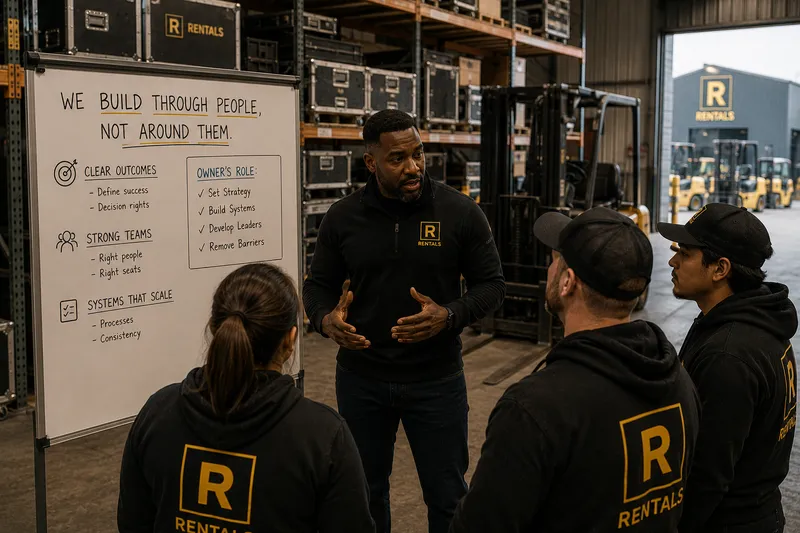
6 Leadership Transfer Strategies to Help Your Rental Business Scale Beyond the Owner
Most rental businesses stall because the owner never stops to delegate. Growth requires a different kind of leadership; one that builds through people, not around them.
A business that runs through systems, not through you
There is a growth ceiling that almost every rental business hits, and it is rarely the one the owner expects. It is not a market ceiling. It is not an inventory ceiling. It is not even a staffing ceiling. It is an owner ceiling. The business has grown to the point where every important decision still runs through one person, and that person is already at capacity. The company cannot move faster than its slowest bottleneck. And the bottleneck is the founder.
That is not a character flaw. It is a structural problem, and it is one of the most predictable growth constraints in event and equipment rental, because rental is a business where the owner is often deeply embedded in daily operations, customer relationships, and problem-solving for years before the question of delegation even becomes urgent. By the time it becomes urgent, the habits are deeply set and the business has been built around a single person's judgment and involvement without a system to replace it.
Leadership transfer is the process of building that system. This does not mean stepping away, rather, it is about building the infrastructure that allows the business to grow without requiring your presence in every decision, every crisis, and every customer interaction. Here is what it means, why it matters, and how to do it.
What Leadership Transfer Is
Leadership transfer is the deliberate process of moving decision-making authority, accountability, and ownership from the founder or owner into a management system that can carry those responsibilities reliably without constant owner intervention. It is not a single event. It is not hiring a manager and disappearing. It is building the clarity, training, and follow-up infrastructure that makes real delegation possible.
The distinction matters because most delegation attempts fail at exactly this point. An owner decides to delegate. They hand something off to a team member or manager. That person struggles because the expectation was vague, the training was incomplete, or the authority boundaries were never defined. The owner steps back in. Confidence in the team drops. The owner becomes busier than before and more convinced that nobody else can do it right. That cycle is one of the most expensive and common patterns in growing rental businesses.
True leadership transfer is not about blind trust, but about structured transfer. The outcome, the standard, the success metric, the decision rights, and the follow-up cadence all exist before the handoff happens. When those elements are in place, delegation produces real ownership. When they are absent, delegation produces confusion and cleanup.
Why It Matters in Rental Specifically
Event and equipment rental businesses are unusually vulnerable to founder bottlenecks because the work is high-stakes, operationally complex, and customer-visible. Every job that goes wrong reflects on the owner's reputation. Every decision that gets made poorly costs real money in damaged relationships, missed deliveries, or equipment downtime. It is understandable that owners want to stay close to the work. The problem is that closeness becomes control, and control becomes the ceiling.
A Gallup study published in early 2025 found that only 46 percent of U.S. employees strongly agreed they clearly knew what was expected of them at work. That is an execution problem rooted in unclear leadership. When team members do not know what they own, what they can decide, and what success looks like, they stop making decisions. They wait. They escalate everything upward. And the owner who was trying to delegate finds themselves doing all the same work they were doing before, plus managing the person who was supposed to take some of it.
In rental, this pattern shows up in specific ways. The dispatch manager who calls the owner before making any routing change. The warehouse lead who waits for approval before swapping an unavailable item. The sales rep who cannot give a customer a quote without checking first. The branch manager who handles every customer complaint personally because the team was never given a resolution framework. Each of these is a symptom of the same underlying condition: the business has not yet transferred leadership, so all roads still lead to the owner.
How to Build It
01
Define outcomes, not just tasks
The first and most common failure point in delegation is handing off a task instead of handing off an outcome. "Handle customer follow-up" is a task. "Ensure 95 percent or more of customers are followed up with within 24 hours, with no dropped communication" is an outcome. The first creates activity. The second creates ownership.
For every role that receives new responsibility, define what success looks like before the handoff. What is the measurable result? What is the standard? What decision authority does this person have? What requires escalation and what does not? In event rental, that might mean a warehouse manager who owns the pull-and-stage process completely, has authority to substitute items within defined categories, and escalates only when a substitution would change the order value by more than a defined threshold.
In equipment rental, it might mean a counter manager who owns rental agreements, rate approvals within a defined range, and customer issue resolution up to a defined dollar amount without owner involvement. Clarity is not a soft idea. When it is absent, the business pays for it in repeated escalations, inconsistent execution, and an owner who cannot step back from the operation.
02
Invest in context, not just instruction
Most training in rental businesses covers the what: how to pull an order, how to process a return, how to write a contract. Fewer businesses invest in the why and the when: why this standard exists, when to use judgment versus when to follow the process exactly, and how to make a good decision in an ambiguous situation. That gap is what produces team members who can execute known tasks but freeze or escalate when anything unexpected happens.
Leadership transfer requires training that builds judgment, not just compliance. That means walking people through how you think about problems, not just what you do about them. It means sharing the context behind decisions so that team members can eventually make similar decisions without needing the owner's input. MIT Sloan's research on delegation notes that leaders often struggle to let go because they fear others will not execute at the needed level. The answer to that fear is not tighter control. It is better training combined with clear standards and consistent follow-up that builds confidence on both sides of the handoff.
03
Apply the delegation confidence equation
Leadership transfer succeeds or fails based on three variables. When any one of them falls to zero, delegation breaks down regardless of how good the intention behind it was.
Delegation Confidence = Clarity × Training × Follow-Up
Clarity
The person understands the outcome, the standard, the success metric, the boundaries, and the decision rights.
Training
The person has been given process, context, tools, and enough judgment to act well without constant guidance.
Follow-Up
The owner inspects what they expect. Not to micromanage, but to stay intelligently engaged until trust and competence are both established.
Follow-up is where most delegation attempts quietly fail. The owner makes the handoff, steps back, and either disappears entirely or jumps back in the moment something goes wrong. Neither extreme builds the team's capacity. A practical rule: for every ten hours of delegated work, invest one hour in reviewing outcomes, coaching on gaps, and reinforcing standards. That oversight is not a sign of distrust. It is a sign of investment. Over time, as competence and track record build, the oversight can lighten. But it should never go to zero entirely.
04
Define what the team can decide without you
One of the most powerful and underused tools in leadership transfer is a clear decision boundary map. This is a simple, documented framework that answers the question every team member has but rarely asks directly: what am I allowed to decide on my own?
Without this clarity, most team members default to escalating everything upward. Not because they lack confidence or capability, but because the consequences of getting it wrong feel unpredictable. They do not know where the line is, so they do not step across it. Autonomy without clarity creates risk. Clarity creates confidence. When team members know precisely which decisions are theirs, which require a manager's approval, and which require the owner's sign-off, they move faster, second-guess less, and the owner gets time back for the decisions that actually require their judgment.
In equipment rental, that might look like counter staff who can approve daily rate adjustments within a defined range, branch managers who can authorize equipment substitutions up to a defined cost difference, and the owner who makes all decisions involving fleet purchases, new account agreements, and dispute resolutions above a defined dollar amount. Every level of that structure produces faster decisions, cleaner handoffs, and a team that operates with appropriate confidence rather than perpetual hesitation.
05
Build accountability into the rhythm, not just the response to problems
Accountability in most rental businesses activates only when something goes wrong. A mistake gets made, and suddenly standards are enforced and conversations happen. That reactive pattern creates a culture where accountability feels like punishment rather than professionalism. And teams that associate accountability with punishment find ways to hide problems rather than surface them.
Leadership transfer requires building accountability into the operating rhythm before problems occur. Weekly one-on-ones where performance is reviewed against clear expectations. Regular check-ins where team members report on the outcomes they own. A culture where bringing a problem forward, especially with a proposed solution, is rewarded rather than penalized. McKinsey's research on organizational health consistently shows that accountability begins with clarity, and organizations with stronger clarity around roles and performance management outperform those that do not. In rental, where operational mistakes compound quickly, a team that surfaces problems early is worth significantly more than one that surfaces them late.
06
Stop answering every question and build decision-making muscle instead
One of the simplest and most impactful behavioral changes an owner can make is to stop providing answers on demand. When a team member comes with a question, replace the answer with a question: what do you think we should do? That one habit, applied consistently over time, builds decision-making capacity in the team rather than dependence on the owner.
Require that problems come with proposed solutions attached. When someone brings a challenge, the standard is that they also bring their recommended response and the impact of that response. That structure shifts the team from problem-reporters to problem-solvers. It is the difference between a team that waits for direction and one that generates it. In both event and equipment rental, where fast decisions during a job or event are unavoidable, a team that cannot make good decisions without the owner is a team that creates risk every time the owner is unavailable.
The Before and After of Leadership Transfer
Without leadership transfer
All decisions route through the owner
Team escalates everything upward
Owner is the bottleneck on growth
Mistakes stay hidden to avoid blame
Business stalls when owner is absent
Owner cannot step back strategically
Delegation attempts fail and repeat
Burnout and fragility compound
With leadership transfer in place
Decisions happen at the right level
Team owns outcomes, not just tasks
Owner regains strategic capacity
Problems surface early and get solved
Business runs when owner is away
Growth is not limited by one person
Delegation builds on itself over time
Leadership becomes proactive
The Desired End State
The goal of leadership transfer is not to remove the owner from the business, but to remove the business's dependence on the owner for its day-to-day function. When leadership transfer is working, the owner can be out of the operation for a week and come back to find that decisions were made well, problems were handled, and the team did not wait for permission to execute. That is not a fantasy. It is what happens when clarity, training, and accountability are built into the system rather than carried in the owner's head.
When teams mature through this process, several things happen simultaneously. Decisions improve because the people making them have real context and real authority. Ownership increases because team members have stakes in outcomes rather than just tasks. Issues surface earlier because the culture rewards transparency rather than penalizing mistakes. And the owner regains the strategic time and mental bandwidth that growth actually requires: time to think about where the business should go, not just to manage where it is today.
Where to Start This Week
→Identify your top three owner bottlenecks: What decisions flow to you daily that do not require your specific judgment? Those are your first delegation targets.
→Build one outcome definition: Choose one role and write a one-page document defining the outcome, the standard, the success metric, and the decision boundaries for that person. That document is your first real transfer.
→Stop answering the next three questions: When someone asks you something they could reasonably answer themselves, replace your answer with "what do you think we should do?" Track what happens over two weeks.
→Schedule a weekly one-on-one with each direct report: Not a problem-solving session. A structured check-in on the outcomes they own, what is working, and what needs support.
→Audit your Accountability Ladder: Rate your business from 1 to 5 on hiring right, training clearly, setting expectations, reinforcing consistently, and leading relentlessly. Your lowest score is your first priority.
Leadership transfer is not a one-time project. It is an ongoing shift in how the business is designed to run. It takes longer than most owners expect and requires more intentionality than most delegation attempts provide. But the businesses that make this shift successfully are the ones that break through the owner ceiling and discover that real scale was always possible. They just needed to build the system to carry it.
The rental businesses that consistently outperform are not the ones where the owner works the hardest. They are the ones where the owner has built a team that works well without needing to be rescued. That is not a loss of control. That is what leadership actually looks like when it is working.


