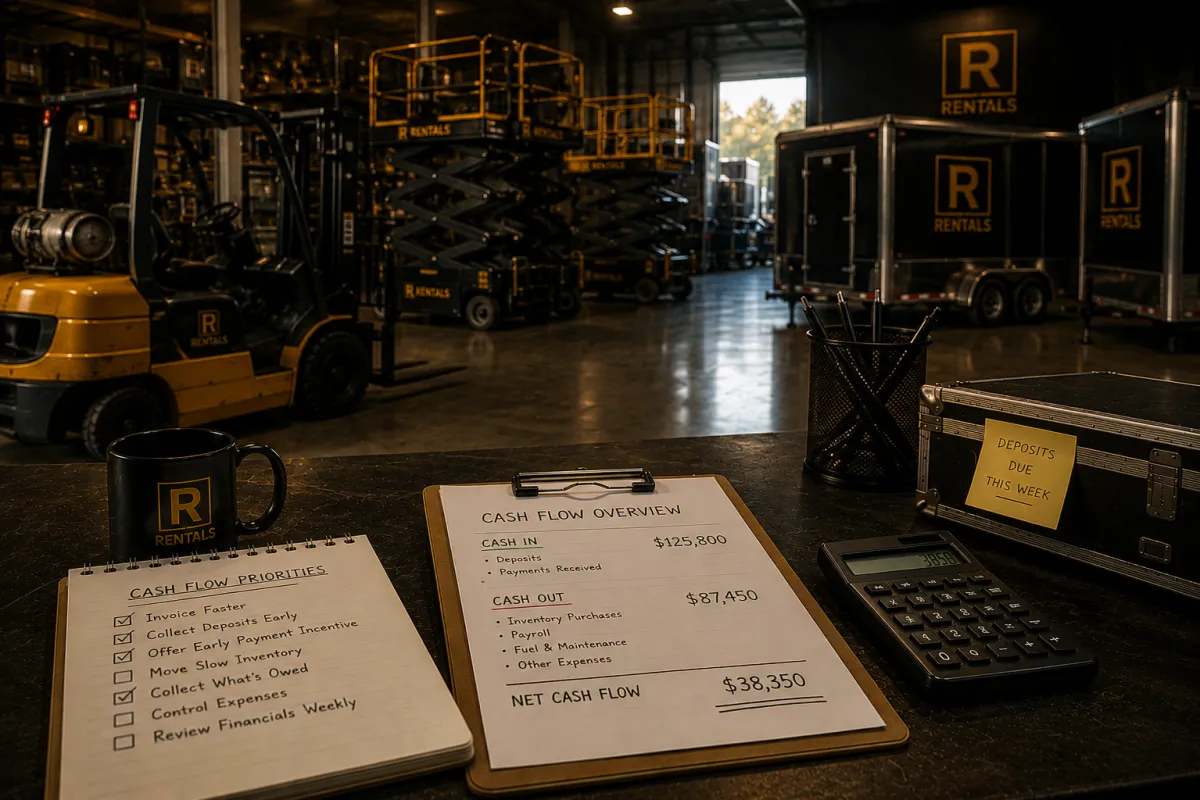
7 Non-Sales Moves to Improve Cash Flow in Your Equipment Rental Business
More rentals will not fix a cash flow problem caused by slow billing, poor fleet decisions, and debt service that does not match your revenue cycle. Here is where to look first.
Equipment rental is one of the more capital-intensive small businesses. You are carrying significant debt or depreciation on fleet, absorbing unpredictable repair costs, paying for fuel and labor whether inventory is renting or not, and waiting on customers who have their own payment cycles and rarely feel urgency about yours.
When cash feels tight, the instinct is to push for more rentals, higher utilization, more accounts, or more volume. Sometimes that is the right call. But more often, the opportunity that is missed is in recovering the cash that is quietly leaking out of the business you are already running. Here are seven non-sales moves that equipment rental operators can make right now.
01
Tighten your billing cycles
Many equipment rental operators bill on a monthly cycle regardless of when a unit returned. A machine that came back on the 8th sits in an unbilled state until invoices run at the end of the month. That is three weeks of completed revenue sitting in a queue while your fuel, labor, and financing costs continue to accrue. And if the customer has net terms, that starts at the moment they are billed, not when the unit returned. For businesses running dozens or hundreds of active rentals, the unbilled balance at any given time can be substantial.
Shifting to return-triggered billing, where the invoice generates automatically when the unit is checked back in, which eliminates that gap entirely. It also removes the end-of-month billing crunch that creates errors, delays disputes, and slows collections. Pair this with a review of your payment terms for smaller accounts. Net 30 is an industry default, not a requirement. Many operators are moving to net 15 or net 7 for smaller transactions, reserving extended terms for large accounts where the volume justifies the accommodation. Every day you accelerate between return and payment is a day of improved cash position across your entire active fleet.
Pro-tip: for those who are on monthly billing, switch to billing every 4 weeks, and you will add in a 13th billing period in the year and increase your revenue by 8%.
02
Sell the assets that are costing you more than they earn
Every piece of equipment in your fleet that is not renting is not sitting at zero cost. It is carrying insurance, financing or depreciation, maintenance readiness costs, and yard space that could hold something earning revenue. Operators who hold onto underperforming assets longest tend to do so for the same reasons: what was paid for it, the belief that demand will return, or the reluctance to recognize a bad purchase decision. All three are expensive positions to maintain.
Run a hard utilization report on your fleet right now. Any asset with below average utilization without a clear seasonal explanation is a candidate for sale or disposal. The cash recovered from selling a chronically underperforming asset has three immediate benefits: it eliminates the ongoing carrying cost, it removes the insurance and maintenance burden, and it generates a lump sum that can service debt, fund a higher-demand asset, or simply strengthen your cash reserves. Selling a piece of equipment is not an admission of failure. It is capital discipline and it frees resources to deploy where the return is actually there.
03
Revisit your fleet financing terms and structure
Most equipment rental operators financed their fleet at the time of purchase and have not revisited those terms since. Interest rates shift. Lender relationships mature. Your business credit profile changes as you build a track record. And the financing structure that made sense when you bought a piece of equipment may look very different now that you understand how it actually performs in your market.
There are several levers worth exploring. Refinancing higher-rate notes at current market rates on assets with strong utilization can meaningfully reduce monthly debt service without changing anything about how the equipment performs. Extending loan terms on assets that are performing but creating short-term cash pressure lowers the monthly obligation at the cost of total interest paid. This is a trade-off that is sometimes worth making when working capital is the constraint. For assets approaching end of financing with strong remaining life, a sale-leaseback arrangement with a lender converts equity in the asset back into liquid cash while keeping the equipment in your fleet. None of these conversations happen unless you initiate them, and most lenders who want to retain a performing commercial account will engage seriously when asked.
04
Tighten your AR process and enforce your terms consistently
Equipment rental AR tends to drift. A large contractor account gets extended terms because they are a valued relationship. A long-standing customer is allowed to run a balance because nobody wants the awkward conversation. A different large account pays on their cycle regardless of what your invoice says, and over time that just becomes how it works. The result is an aging report full of balances that are technically current by relationship standard but weeks or months overdue by your actual terms.
The fix requires treating your payment terms as a real policy rather than a starting point for negotiation after the fact. Build a weekly AR review into your operations rhythm. Invoices at 7 days past due get a system-generated reminder. At 14 days, a call from your office. At 30 days, a hold on additional rentals for that account until the balance is resolved. For accounts that consistently pay late, consider requiring a credit card on file or a deposit on future rentals. The accounts most likely to push back on that requirement are usually the ones with the most persistent AR problems, which tells you exactly where the policy is most needed.
05
Reduce repair cost spikes with a maintenance reserve fund
One of the most disruptive cash flow events in equipment rental is a major repair bill that was not planned for. An engine rebuild, a hydraulic system failure, a transmission on a machine that was running fine last week. These are not surprises in a fleet business. They are certainties. The only question is timing. Yet most equipment rental operators handle major repairs reactively, paying for them from operating cash when they arrive and absorbing the hit to the month's position.
A maintenance reserve fund treats fleet repairs the same way a responsible homeowner treats a roof replacement, as a predictable future cost that should be funded incrementally rather than paid for in a single painful moment. Set a monthly reserve amount based on your fleet's age, size, and historical repair spend. Even a modest per-unit monthly contribution builds a buffer that absorbs major repairs without touching operating cash. Pair this with usage-based PM scheduling so preventive maintenance is driven by actual hours rather than just the calendar, which reduces the frequency and severity of unplanned failures over time. The reserve does not eliminate repair costs. It eliminates the cash crisis that comes with them.
06
Generate cash from assets that are sitting without selling them
Before selling an underperforming asset, there is an intermediate option that most equipment rental operators underuse: peer-to-peer or wholesale rental agreements with other operators. If you have equipment sitting in your yard during a slow period that a peer operator in a different market needs, a short-term sublease arrangement generates revenue from an asset that would otherwise be a pure carrying cost. Many equipment rental associations and regional networks have informal arrangements for exactly this purpose, and more formal platforms now exist to facilitate it.
For equipment that is seasonally slow rather than chronically underperforming, a targeted flash promotion to your existing account base can move utilization during off-peak windows without permanently discounting the asset. A time-limited rate on a specific category, offered only to active accounts via direct outreach, often generates bookings that would not have come in through passive availability. Require a signed rental agreement and a card on file to access the promotional rate. That keeps the transaction clean and ensures the discount is not being extended to accounts with existing AR problems.
07
Renegotiate vendor terms and audit every recurring cost
Your fuel supplier, parts distributor, tire vendor, insurance carrier, telematics platform, rental software provider, and equipment cleaning or transport contractors are all relationships that were priced at a point in time and have likely never been revisited. If your business has grown, your payment record is clean, and your volume with any of these vendors has increased, you have standing to ask for better terms. Extended payment windows, volume-based pricing, or consolidated billing cycles that align with your own cash collections are all reasonable asks from a vendor who wants to retain a reliable commercial account.
Pull every recurring charge from your statements for the last 90 days and build a single list. Flag anything that is auto-renewing without review, duplicative across tools, or priced at a rate that predates your current volume. Telematics and fleet management software in particular has become increasingly competitive, so if you have not benchmarked your current provider against alternatives in the last two years, you are likely overpaying. And credit card processing rates on equipment rental transactions, which tend to run large, deserve the same scrutiny they do in any high-volume business. A half-point reduction on processing rate across significant annual card volume is a material dollar amount recovered from a single conversation with your processor.
Equipment rental businesses that struggle with cash flow are rarely struggling because they lack revenue. They are struggling because capital is locked in the wrong places, billing is slower than it needs to be, debt service was structured for conditions that no longer exist, and the vendors and overhead costs that drain the business each month have never been challenged.
None of these moves require a new customer. They require a clear-eyed audit of how cash is moving through the business you already have and the discipline to tighten the gaps one at a time. Start with the one that resonates most. The compounding effect of several small fixes often outperforms the impact of one new account.


