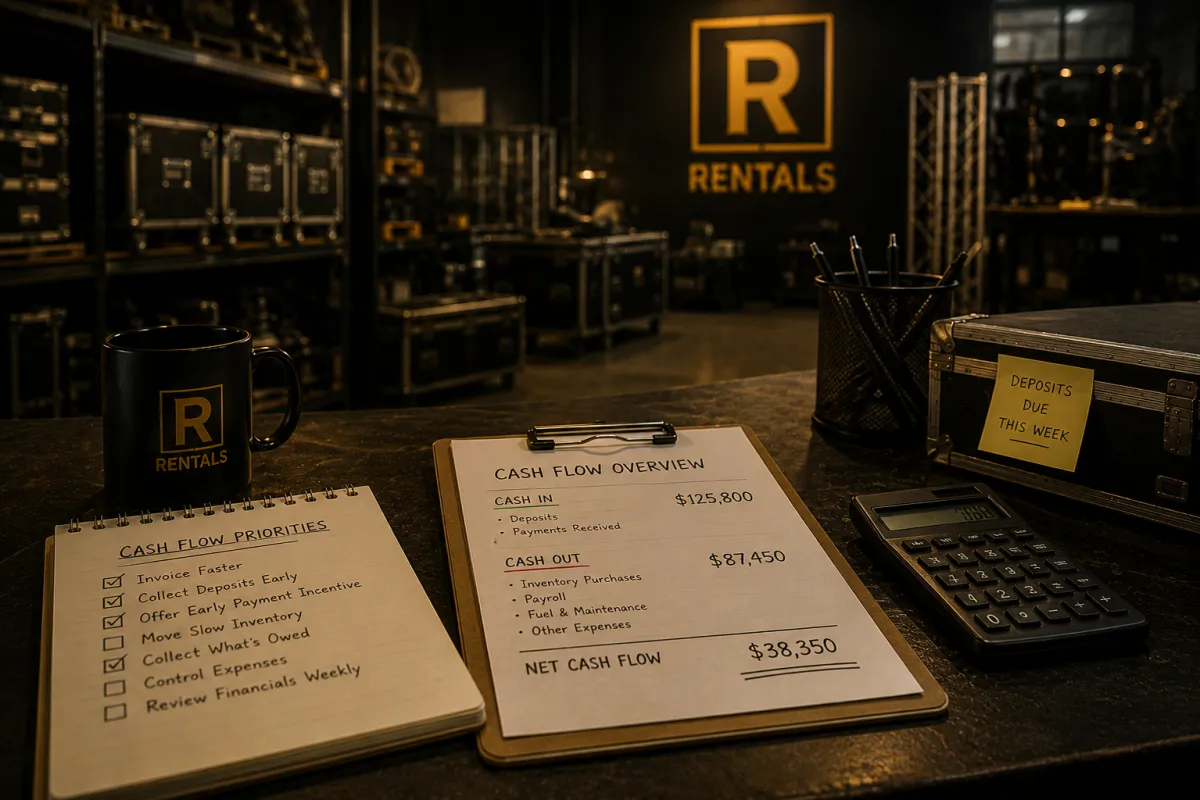
7 Non-Sales Moves to Improve Cash Flow in Your Event Rental Business
You do not always need more bookings to improve your cash position. Sometimes you need to stop the bleeding that is already happening.
Event rental is a cash-intensive business. Inventory has to be purchased, maintained, and replaced. Crews have to be paid. Trucks have to run. And all of that spending happens whether the month is busy or slow, whether deposits came in on time or late, and whether final balances were collected before or after the event truck rolled out the door.
When cash feels tight, the instinct is to look for more revenue. But often, the faster opportunity is not in generating new cash. It is in stopping the quiet, structural drain on the cash you are already producing. Here are seven non-sales moves event rental operators can act on right now.
01
Send final invoices faster and tighten payment terms
In event rental, the gap between when the job ships and when the final invoice goes out is one of the most controllable cash flow levers available, and one of the most commonly ignored. Crews return late. The warehouse is chaotic on Monday morning. Billing gets handled when things calm down. Three days pass. Sometimes five. That delay is free money you are lending your customers with no agreement to do so.
The fix is a billing discipline standard: final invoices go out within 24 hours of inventory return and check-in completion, no exceptions. Pair that with a review of your payment terms. If you are collecting final balances net 30 after the event, consider shifting to net 7, or collecting the full balance before delivery when able. Many event rental companies are moving to pre-event payment in full for new and one-time clients. Customers who are serious about their event rarely push back when the expectation is set clearly at booking. Every day you shorten between delivery and collection is a day of improved cash flow compounded across every order you run.
Pro tip: assess final payment when you enter your cancellation window. If you allow cancellations 2 weeks out, assess the payment then. Any changes within that period, such as inventory additions, must be paid in full when the request is confirmed.
02
Restructure your deposits to collect more cash earlier
Deposits are an underutilized cash flow tool in event rental. Most operators collect 25 to 50 percent at booking (or less) and the balance at or after the event. That structure means the majority of your cash arrives at the end of the cycle, after labor, fuel, and logistics costs have already been paid.
A 50 percent deposit at booking with the balance due 14 days before the event puts money in your account before the truck is ever loaded. For tent installs, large corporate setups, and multi-day events where labor exposure is significant, a higher pre-event collection is not aggressive, it is a reasonable protection of your working capital, and most professional clients in the wedding, corporate, and hospitality space expect it.
Deposit structure comparison
Standard: 25% at booking, balance due net 30 after the event
Improved: 50% at booking, 50% due 14 days before delivery
Best: 60%+ at booking, remainder due 14 days before delivery
New clients: 100% due at booking
03
Offer a small incentive for early or ACH payment
A modest early payment discount, such as 2 percent off for payment received in full at the time of booking, costs you a fraction of what a late payment or collections conversation costs in time, energy, and relationship friction. For a $3,000 order, that is $60. If it consistently moves payment months earlier across your recurring accounts, the working capital improvement far outweighs the discount.
The same logic applies to ACH and check payments. Credit card processing fees in the 2.5 to 3.5 percent range are real margin on every transaction. Offering a small incentive for customers who pay by ACH removes that fee entirely on those orders. Many corporate and venue accounts that book regularly will appreciate the option and you won't have to incentivize . You can also extend this forward: a returning client who pays the deposit on their next event at checkout gets a small credit or a priority booking window, simultaneously improving your cash position and your retention rate.
04
Turn underperforming inventory into cash
Every event rental warehouse has it. The specialty charger plates that were trendy three years ago. The linen color that never moved. The glassware set requested once a season. Specialty furniture that looked great in the catalog and has sat on the shelf since. This inventory is not neutral. It occupies space, consumes labor every time it gets counted or moved, and represents capital that could be working elsewhere in the business.
A bundled promotion can introduce slow-moving items to customers who would not have rented them otherwise. A direct flash sale to your existing client list with a time-limited discount often moves inventory faster than anything else. For available weekends with gaps in the calendar, offer a discounted rate and require a deposit to secure it, that collects cash now and locks in a booking that would otherwise have been empty. A slim margin beats money sitting on a shelf indefinitely.
05
Get serious about collecting what you are already owed
Outstanding receivables are cash that belongs to you sitting in someone else's account. In event rental, AR accumulates with corporate clients, venue accounts, and planning companies operating on their own net-30 or net-45 cycles regardless of your terms. When collections are passive, waiting for payment to arrive rather than actively managing the aging, the total outstanding balance grows quietly while the cash gap widens.
Build a simple AR rhythm. Invoices unpaid at 7 days past due get a courteous reminder. At 14 days, a direct call from your office. At 30 days, a hold on future bookings for that account until the balance is cleared. That sequence is professional, not aggressive, and signals that your payment terms are actual expectations rather than suggestions. Run an aging report weekly, not monthly. The longer a balance sits without contact, the harder it becomes to collect and the more it normalizes for the customer.
06
Negotiate better terms with your vendors and suppliers
Your linen supplier, cleaning chemical vendor, laundry service, packaging and supplies distributor, and every recurring vendor relationship in your business is a potential cash flow lever most operators leave untouched. If you have been a consistent, reliable customer for more than a year, you have standing to ask for extended payment terms, volume pricing, or seasonal flexibility that accommodates your cash cycle rather than working against it.
Additionally, if you are looking to switch your business to another vendor, terms is another area to negotiate and they will be incentivized to comply in order to win your business.
You are not asking for a favor. You are presenting a business case: you are a reliable account, your volume has grown, and you would like to discuss terms that reflect the relationship. Most vendors prefer negotiating with a known customer over finding a new one. You may be surprised how many will agree to net-45 or net-60 terms, seasonal billing arrangements, or pre-committed order discounts without significant resistance. You will never know until you ask, and the cost of asking is zero.
07
Audit every recurring charge and then cut or renegotiate
Software subscriptions, insurance policies, merchant processing agreements, phone and internet plans, storage leases, equipment rental agreements, cleaning supply contracts and every recurring monthly obligation should be reviewed together at least once per year. Most event rental operators have never done this as a single consolidated exercise, and the results are almost always surprising.
Pull every recurring charge from your bank and credit card statements for the last 90 days and build one list. For each item ask: Is this actively being used? Is the current rate the best available today? Has this auto-renewed without anyone reviewing the terms? Credit card processing deserves particular attention. A rate of 2.9 percent on $800,000 in annual revenue is $23,200 per year in fees. Negotiating that down by even half a point saves over $4,000 annually with one phone call. Most event rental businesses accepted the rate they were quoted at setup and have never revisited it.
None of these moves require a new booking, a new marketing campaign, or a new customer. They require a clear-eyed look at the structural gaps between when your business spends money and when it collects it, and the discipline to close those gaps one at a time.
Cash flow in event rental is rarely a revenue problem. It is almost always a timing, collections, and overhead problem. Fix the timing. Manage the collections. Audit the overhead. The cash that was already there starts showing up in your account the way it was always supposed to.


