
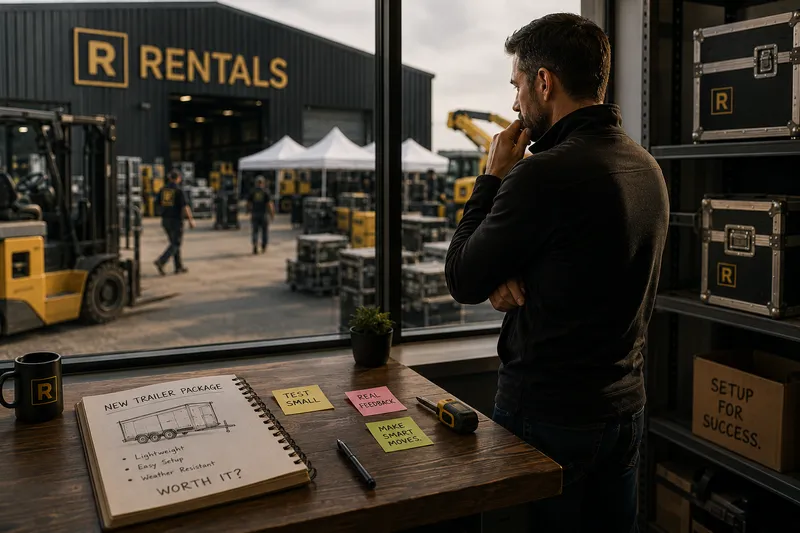
7 Lessons from The Lean Startup to Apply to Your Event or Equipment Rental Business
Eric Ries wrote The Lean Startup for software companies. But the principles inside it apply just as powerfully to businesses that move equipment, linens, tents, and machinery. Here is how.
Eric Ries published The Lean Startup in 2011. The book was aimed at technology founders building products in conditions of extreme uncertainty. But the core problem Ries was solving is not unique to software. It is the same problem facing every rental business owner who has ever purchased inventory that never moved, built a process nobody followed, launched a service nobody wanted, or spent months preparing something that the market received with a shrug.
The Lean Startup argues that businesses fail not from a lack of planning, but from planning the wrong things. The antidote is not better planning. It is faster, smarter testing. Build the smallest version of an idea that can generate real feedback. Measure what actually happens. Learn from it. Adjust. Then go again. That loop applies to a software startup and to a tent company deciding whether to add a new product line with equal force. Here are the lessons that translate most directly into rental.
01 The Build-Measure-Learn Loop
Stop perfecting ideas in isolation and test them cheaply first
The Build-Measure-Learn loop is the central idea of the book. Instead of investing heavily in a fully developed product or service before exposing it to the market, you build the smallest version that can generate real customer feedback, measure how customers actually respond, and then decide whether to continue, change direction, or abandon the idea entirely.
In rental, the equivalent is launching a minimum viable version of an idea before committing the capital, inventory, or operational redesign that a full rollout would require. A new equipment category does not require a full fleet purchase to test. Offer it on a sublease or purchase a used version and see what the demand actually looks like before scaling. A new event rental service package does not require a full marketing campaign. Pitch it to ten existing clients and measure their response. A new delivery model, a new pricing tier, a new add-on service. All of these can be tested in a smaller, cheaper form before they consume real resources.
The trap most operators fall into is the opposite of this: building the complete version first, then discovering what the market thinks. That sequence is expensive in capital, in time, and in opportunity cost. Building small and learning fast is not cutting corners. It is spending the cheapest possible currency, which is time and a small experiment, to find out whether the bigger investment is worth making.
02 Validated Learning
Measure what the market does, not what you think it will do
Ries makes a distinction that most operators feel intuitively but rarely act on: the difference between progress that feels real and progress that is real. A business can feel like it is moving forward because it added inventory, updated its website, hired a new salesperson, or redesigned its warehouse. Those are activities. Validated learning asks whether any of those activities changed customer behavior in a measurable way.
In rental, validated learning means building a habit of connecting every investment or initiative to a measurable outcome and then checking whether that outcome actually happened. Did the new equipment category generate the rental volume you projected, or did it sit? Did the new pricing tier improve margin, or did it drive customers to competitors? Did the sales training move the quote conversion rate, or did the team simply feel more confident without closing more business? Activity is easy to generate. Validated learning requires discipline to measure honestly and the courage to act on what the data says rather than what you hoped it would say.
03 Vanity Metrics vs. Actionable Metrics
Stop measuring what makes you feel good and start measuring what tells you the truth
Ries calls them vanity metrics: numbers that look good in conversation but do not actually tell you whether the business is working. Total revenue is a vanity metric if margin is deteriorating. Total orders placed is a vanity metric if a significant share are below break-even. Social media followers are a vanity metric if none of them become customers. These numbers feel like progress, but they can mask a failing strategy for a long time.
Actionable metrics in rental are the numbers that connect directly to the decisions you need to make. Time utilization by asset class, not fleet-wide averages. Margin by job type and customer segment, not blended company margin. Quote conversion rate by sales rep and by channel, not total quotes sent. Customer retention rate by account tier, not total active customers. These metrics are harder to track and less flattering to present, but they are the ones that tell you where the business is actually healthy and where it is hiding problems behind busy activity.
Event Rental
Track margin by event type and client segment. A busy wedding season can still produce weak margins if the job mix is wrong. Revenue alone will not show you that.
Equipment Rental
Track time utilization by individual asset, not fleet average. A 65% fleet average can hide categories running at 90% and others sitting at 30%.
04 Pivot or Persevere
Know when to adjust direction and when to hold the course
One of the most valuable frameworks in the book is the structured pivot. Ries argues that a pivot is not a failure. It is a deliberate course correction based on validated learning that keeps the vision intact while changing the approach. The key word is structured. A pivot made out of panic, frustration, or boredom is not a pivot. It is drift. A pivot made because the data clearly indicates that one element of the strategy is not working is a sign of intellectual honesty and operational discipline.
Several types of pivots apply directly in rental. A customer segment pivot happens when a company finds that its product or service works better for a different customer type than the one it originally targeted. An event rental company that started serving backyard parties might discover that corporate clients are dramatically more profitable and easier to serve at scale. An equipment rental company targeting homeowners might find that small contractors produce far better economics.
A pricing model pivot happens when the structure of how value is captured shifts, moving from flat rates to usage-based billing, or from transactional pricing to contract-based arrangements. Recognizing these moments and acting on them deliberately rather than reactively is what separates a strategic pivot from a business that is just reacting to pressure.
05 The Three Engines of Growth
Know which growth engine your business actually runs on
Ries identifies three sustainable engines of growth. The sticky engine retains customers longer than it loses them, building compounding loyalty over time. The viral engine generates referrals, where each customer brings in more customers through word of mouth or built-in network effects. The paid engine converts revenue per customer into new customer acquisition, where the margin on each job funds the cost of finding the next one.
Most rental businesses rely on a combination of all three, but usually one engine dominates. Understanding which one drives your business is not a theoretical exercise. It determines where you should invest your time and money to grow. If your primary engine is sticky, your highest-leverage investment is in client experience, post-rental communication, and account management that deepens relationships and reduces churn.
If your primary engine is viral, your highest-leverage investment is in making it easy and rewarding for happy customers to refer others, and in building the kind of reputation that planners, contractors, and project managers talk about without being asked. If your primary engine is paid, your highest-leverage investment is in understanding your acquisition cost versus customer lifetime value and building marketing channels with a known and positive return.
06 Five Whys
Ask why five times before you act on a problem
Borrowed from Toyota's lean manufacturing system, the Five Whys technique is one of the most practically useful tools in the book. When something goes wrong, the temptation is to fix the visible problem and move on. The Five Whys forces you to trace the problem back to its root cause by asking "why" repeatedly until you reach the systemic issue underneath the surface symptom. Surface fixes address what happened. Root cause fixes address why it keeps happening.
In a rental business, where operational mistakes are visible, fast-moving, and sometimes expensive, the Five Whys is an especially powerful tool. It prevents the cycle of patching the same problem repeatedly and builds the kind of institutional learning that makes the operation stronger over time rather than just busier.
Problem
A tent was installed incorrectly and the client called with a complaint the morning of the event.
Why 1
The crew installed it differently than the venue diagram showed.
Why 2
The crew lead did not have the diagram on-site during installation.
Why 3
The diagram was only shared digitally and the crew lead's phone battery was dead.
Why 4
There is no standard process for confirming that installation documents are accessible before a crew departs the warehouse.
Root Cause
The business lacks a pre-departure confirmation checklist that includes document access verification. The fix is a system, not a performance conversation with one crew lead.
07 Small Batches
Release in small increments to help surface problems faster and reduces waste
One of the counterintuitive insights in The Lean Startup is that releasing in small batches is almost always faster than large batch production, even though it feels slower. The reason is that large batches defer the discovery of problems. A rental company that designs a complete new service offering, trains the entire team, builds all the supporting materials, and launches company-wide all at once will discover its problems at the worst possible moment: when everything is already deployed. A company that launches the same offering to one branch, or with one sales rep, or with one customer segment first will discover its problems early, cheaply, and with the flexibility to fix them before they scale.
This maps directly to the "move before you are ready" principle that strong rental operators already practice. The instinct to wait until something is fully polished before deploying it is understandable. The cost of that instinct is that the polishing happens in isolation, without the feedback that only real use can provide. Small batches get real feedback early. Real feedback shapes better outcomes than refined assumptions. And the time saved by not building the wrong thing to completion is the most valuable efficiency available to any rental business, regardless of size.
Event Rental
Test a new package, upsell offer, or service tier with one segment of existing clients before rolling it out company-wide. Use that cohort's response to refine the offer before it scales.
Equipment Rental
Pilot a new delivery model, pricing structure, or customer communication system at one branch before deploying across the operation. One location's data is worth more than any internal planning session.
The Lean Startup was written for entrepreneurs operating in radical uncertainty. Event and equipment rental businesses operate in their own version of that uncertainty every season: changing customer demand, unpredictable weather, market shifts, new competitors, and the constant question of which investments will actually pay off and which will sit on a shelf or in a yard collecting carrying costs.
The answer Ries offers is a better process for finding out what works: build small, measure honestly, learn from the data, and adjust before the wrong assumptions have consumed the budget. Those are not just startup principles. They are principles for any business that wants to grow without betting the operation on untested ideas.
Pick one of these concepts and apply it to a decision your business is facing right now. Not all seven at once. One. Build the smallest version. Measure what happens. Then decide what comes next.


