8 Ways the Best Event and Equipment Rental Businesses Scale
Most rental businesses grow quickly at first. The owner fills the gaps. A few strong people carry a lot. Decisions happen fast because they all run through one person. That can work for longer than it should. And then it stops working. More jobs, more inventory, more customers, more complexity. What once felt manageable starts feeling untenable.
At that point, the instinct is to chase the obvious answer: more marketing, better people, more inventory, better software. Sometimes those help. More often, they are not the core issue. The rental businesses that scale successfully are not always the ones that move fastest. They are the ones that build the right foundation before they try to carry more weight. Here is what that looks like.
01
They find the real constraint before throwing resources at symptoms
A rental company may think it has a lead problem when the real issue is that quotes take too long. Another may think it has a staffing problem when the deeper issue is turnover caused by operational chaos. Another may think it needs more inventory when the actual problem is poor utilization of what it already owns. Growth does not always stall where it hurts the most. It stalls where the business is most constrained.
The most useful question a rental owner can ask is a simple one: what is the single biggest constraint holding this business back right now? Not ten things that need improvement. The one thing that, if removed, would make several others easier. That level of focus is not narrow-minded. It is the discipline that separates operators who make meaningful progress from those who stay perpetually busy without advancing.
02
They design simplicity before they scale complexity
Many rental businesses do not grow naturally into scale. They grow into complexity. A workaround gets added. A new approval step gets inserted after a mistake. A special-case rule gets created. Each addition is made with good intention, but eventually the business is no longer operating on intentional design. It is operating on accumulated reactions.
The rental businesses that scale best do the opposite. They ask not what the most sophisticated version of a process looks like, but what the simplest version is that still works reliably. Simpler processes are easier to train, easier to execute under pressure, easier to audit, and easier to hand off as the team grows. A business built around heroics feels strong until the wrong person is absent. A business built around simple, repeatable systems scales without the same fragility.
03
They build a management system that transfers ownership with clarity
A founder who believes the next stage of growth depends on finding better people is partially right. The deeper need is a better management system. Good people still need clarity. Good managers still need decision rights. Good hires still need context, training, and feedback. Without those, even a strong person will underperform in a growing business.
The rental businesses that scale through people rather than around them treat delegation as a system rather than an act of hope. That means defining the expected outcome clearly, not just the task. It means building in real follow-up cadence rather than disappearing after the handoff. And it means giving people genuine authority over what they own rather than putting a title on someone while all decisions still run upward. When delegation is done with that level of structure, ownership transfers. When it is done without that structure, the owner ends up busier than before.
04
They build a market position that earns margin instead of competing on price
When buyers cannot clearly explain why one rental company is safer, easier, faster, or more reliable than another, they compare vendors on the most visible variable available: price. That is how discounting becomes a habit and how margin disappears quote by quote. The companies that scale most profitably are not the cheapest. They are the most defined.
Strong positioning in rental is not about sounding impressive. It is about being understandable and relevant to a specific type of customer. An event rental company that owns a clear promise around execution reliability or planner confidence commands a different conversation than one that describes itself with generic language. An equipment rental company that is known for a guaranteed response window or machine readiness does not fight the same price battles as a competitor who says nothing specific at all. Position is the first margin decision, and the businesses that get it right earn the right to stop discounting.
05
They build repeatable revenue from existing relationships before chasing new ones
The most overlooked growth lever in rental is the customer base that already exists. Existing clients do not require the same trust-building as new prospects. They already know the quality of the work. In event rental, planners and venue accounts that book repeatedly are worth more to the business than any equivalent volume of one-time customers. In equipment rental, contractor accounts that consolidate their spend with a single reliable supplier are worth more than a rotating list of transactional customers who are always shopping rate.
Businesses that scale sustainably build deliberate retention and expansion systems around these relationships. Post-rental follow-up processes. Seasonal outreach timed to when customers are planning their next project. Proactive check-ins with top accounts to understand upcoming needs. A structured referral channel that treats word-of-mouth as a managed asset rather than a pleasant surprise. These moves compound over time in a way that cold outreach rarely does.
06
They treat cash and margin as strategic tools, not just financial reports
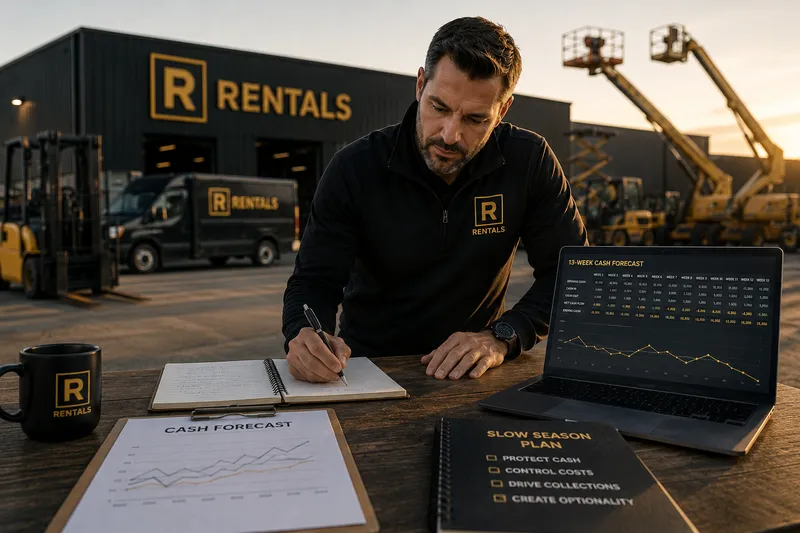
Growth consumes cash before revenue from that growth arrives. New inventory, additional staff, expanded locations, and marketing investment all require spending that precedes the return. Rental businesses that scale successfully are almost always the ones that understood their cash position clearly before they made significant growth commitments.
That means running a rolling cash forecast rather than managing by bank balance. It means setting reserve targets during strong months rather than fully deploying every dollar of peak-season revenue. It means securing a line of credit before it is needed rather than applying from a position of visible pressure. And it means understanding the fully loaded margin on the work and inventory categories that drive the business, so that growth decisions are made toward better economics rather than just more volume. More revenue is not a strategy by itself. More profitable, sustainable revenue is.
07
They hire and develop people intentionally, not reactively
Reactive hiring is one of the most consistent patterns in businesses that stall. When the need is urgent, standards drop, interviews get rushed, and the person who walked in at the right moment gets the job regardless of fit. The cost of that pattern is not just the wrong hire. It is the cultural and operational cost to the people who remain while the business cycles through another avoidable departure.
The rental businesses that scale their teams most effectively stay slightly ahead of demand rather than chasing it. They define roles clearly before they post them, evaluate candidates against consistent criteria, and invest in onboarding that sets people up to perform rather than dropping them into a live environment and hoping for the best. That discipline turns the team into a compounding asset rather than a recurring liability.
08
They decide what kind of business they are actually building
Many rental businesses say they want growth. Fewer have defined what kind. More revenue is not a strategy on its own. It is directionless ambition unless it is tied to a clearer picture of what the business is supposed to become. A premium event company does not build the same way as a lean high-volume regional operator. A business optimizing for eventual sale does not make the same decisions as one the owner intends to run for twenty years.
The businesses that scale most intentionally build today like the future version of the company would operate. They ask whether the $5 million or $10 million version of the business has systems, a real management layer, strong hiring, and clear financial controls. If the answer is yes, those are not later problems. They are today's problems. Growth tends to be more durable when the operating model is already pointed in the right direction before the volume arrives to stress it.
The rental businesses that scale well are not necessarily the ones that grow fastest or spend the most on marketing. They are the ones that found the real constraint, simplified before they expanded, built management systems that work without constant owner intervention, defined a market position worth holding, and made financial decisions with their cash position clearly in view.
None of that is glamorous. But it is what separates the businesses that grow and stay stable from the ones that grow and feel increasingly out of control. Build the foundation first. The volume will find its footing more easily when it does.


