
9 Reasons Why Sales Teams in Rental Businesses Underperform
It is rarely a talent problem. More often it is a systems, structure, and leadership problem. And all of it is fixable.
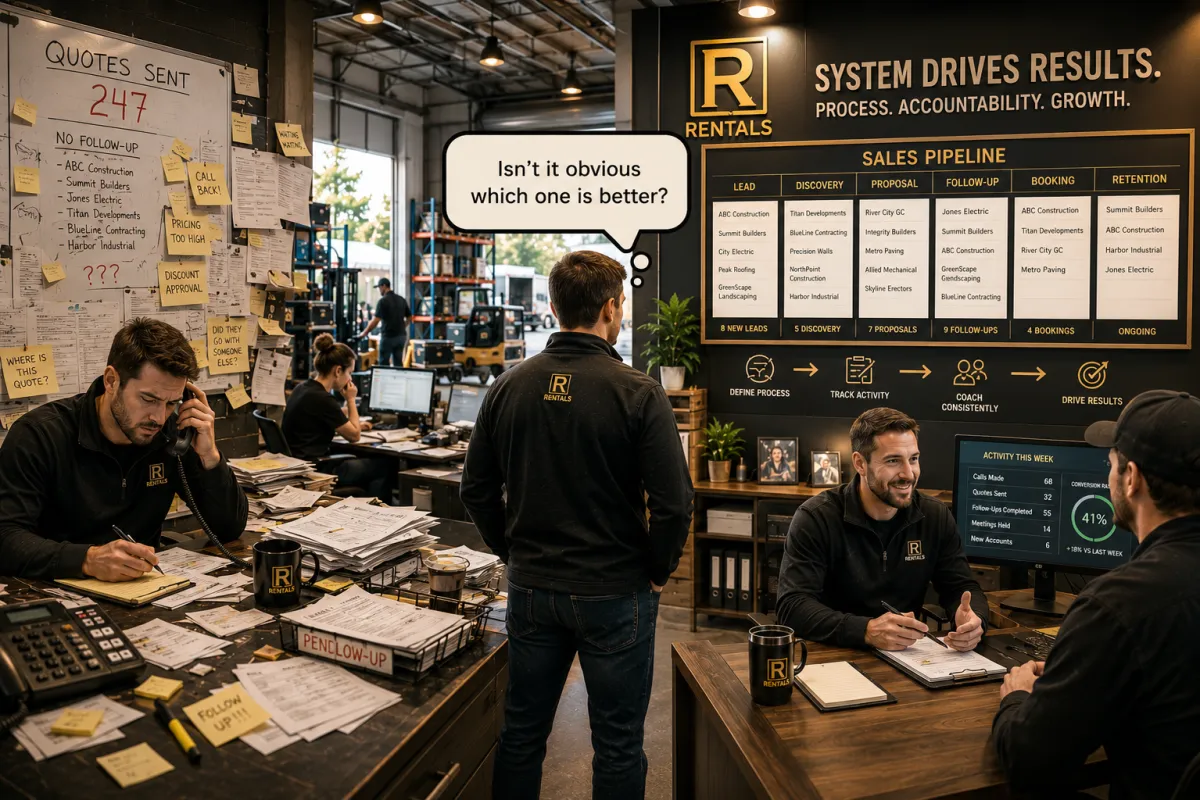
Most rental business owners will tell you their sales team could be doing more. What is harder to pinpoint is exactly why. The instinct is to blame the reps: wrong hires, wrong attitudes, not enough hustle. But in most cases the problem is not simply the people. It is the absence of a system that gives those people a clear process, the right incentives, and the coaching to improve. Here is where it typically breaks down.
01
There is no defined sales process
When every rep handles inquiries differently, results depend entirely on individual personality rather than a repeatable system. One rep qualifies thoroughly and follows up three times. Another sends a quote and waits. Without a shared process covering how to qualify an inquiry, how to structure a quote conversation, and what happens after the quote goes out, you cannot coach, you cannot improve, and you cannot scale. A defined process is not about scripting your team. It is about giving them a framework that produces consistent results regardless of who picks up the phone.
02
The team is quoting, not selling
In most rental businesses, the sales function has quietly become an order desk. A customer calls asking for a specific piece of equipment, the rep quotes it, and the conversation ends. No one asks what else is on the job site, what is coming up next month, or whether there is an application where a different piece of equipment might work better. Responding to demand is not selling. Selling is understanding what the customer is trying to accomplish and positioning your business as the complete solution. That shift in mindset, applied consistently, is one of the highest-leverage changes a rental sales team can make.
You cannot coach effort you cannot measure. And you cannot measure effort you have never defined. Most rental sales managers are evaluating outcomes while ignoring the behaviors that produce them.
03
Incentives are pointed at the wrong outcomes
When commissions are tied purely to gross revenue, reps learn quickly that the fastest path to a paycheck is discounting to close or only chasing the top customers, while neglecting smaller customers who are the bread and . They win the rental, you lose the margin. The incentive did exactly what it was designed to do — it just was not designed with your profitability in mind. Tying compensation to margin, to utilization of specific asset classes, or to new account acquisition aligns your team's financial interest with the health of your business. The right incentive structure does not motivate people — it channels the motivation they already have toward the outcomes that actually matter.
04
No one is tracking the behaviors that drive results
Most rental sales managers track closed revenue and not much else. The problem is that revenue is a lagging indicator — it tells you what already happened. The behaviors that predict future revenue, including calls made, quotes sent, accounts visited, and follow-ups completed, are what actually need to be managed. When activity metrics are absent, coaching has no foundation. You cannot tell a rep to do better when neither of you knows what they are currently doing. Establish a small set of weekly activity expectations, track them consistently, and your coaching conversations go from vague to specific almost immediately.
05
Reps cannot confidently talk about the equipment
This one is specific to rental and it is more common than most managers want to admit. A rep who does not understand the difference between a rough-terrain scissor lift and a slab scissor lift cannot ask good application questions. A rep who has never walked a job site with a customer cannot speak credibly about what a 60-ton crane can and cannot do. When reps lack equipment confidence, they default to quoting whatever the customer asks for rather than engaging in a real conversation about the job. Invest in regular product training, get your reps into the yard and onto job sites, and the quality of every customer conversation improves alongside it.
06
Lost quotes disappear without a trace
Quotes go out and if the customer does not call back, the opportunity is treated as closed. In most rental businesses, a significant share of unconverted quotes are not actually lost — they are simply waiting, and one timely follow-up call would close a meaningful percentage of them. Beyond the immediate opportunity, understanding why quotes are lost is one of the most valuable and underused inputs a sales team has. Was it price? Availability? A competitor with faster turnaround? Without that feedback, the same mistakes repeat indefinitely. A simple follow-up protocol and a lost-quote log costs nothing and teaches you more about your market than almost any other tool.
07
There is no strategy for staying in front of customers between rentals
Existing customers are contacted when they call in. Former customers are not contacted at all. Prospects who were not ready last quarter are forgotten. The result is a sales team that is entirely dependent on inbound demand, with no mechanism for warming relationships between transactions. A rental business nurture strategy does not need to be complicated. Seasonal check-ins tied to when your customers typically have upcoming project needs, a brief email or call after a rental to confirm everything went well, a quarterly touchpoint with your top accounts to understand what is coming, and a simple re-engagement sequence for customers who have gone quiet are all low-effort and high-return. The rental companies with the most loyal customer bases are not necessarily the ones with the best equipment. They are the ones who stayed in the conversation when there was nothing immediate to sell.
08
All accounts are treated the same
When a rep spends equal time on a customer who rents once a year and a customer with the potential to drive six figures of annual revenue, the math never works in your favor. Segmenting your customer base by revenue, by growth potential, and by strategic fit is not a sophisticated exercise — it is a basic allocation of your team's most finite resource, which is their time. Your top accounts should have a named owner, a contact cadence, and a growth plan. Your smallest accounts should be served efficiently through inbound and digital channels so your reps can focus where the return on their effort is highest.
09
The handoff between sales and operations breaks the customer experience
A rep who overpromises on availability, delivery timing, or equipment condition puts operations in an impossible position. When the customer shows up expecting a freshly serviced machine by 7 a.m. and the reality does not match, the relationship damage lands on the rep who made the promise — and on the business that could not keep it. The fix is not just about communication. It is about building shared visibility between your sales and operations teams so that promises are made against real availability and real capacity. When sales and operations are working from the same information, what gets sold is what can actually be delivered.
None of these are permanent conditions. Every item on this list is a systems or leadership problem, which means every one of them is within your control to change. The rental businesses with the strongest sales cultures did not hire better people. They built better processes, pointed their incentives in the right direction, and gave their teams something to be coached against. Start with whichever reason resonates most and work from there.


