
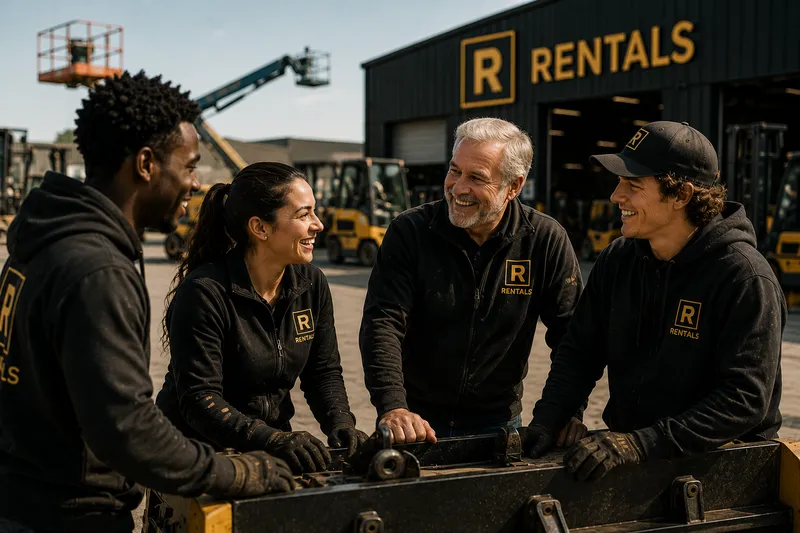
Building an Age-Diverse Team in Event and Equipment Rental
Most rental businesses are age-homogeneous by accident. Event rental often leans young because the work is physical. Equipment rental can lean experienced because the machines are complex. Both assumptions are understandable. Both leave real value off the table.
A team built across generations is more complete than one built around a single profile. The rental businesses that figure this out gain an advantage that is meaningful and consistently underestimated.
Part One · Why Age Diversity Makes Your Team Stronger
01
Different life seasons bring different strengths
Younger team members often bring energy, stamina, adaptability, and comfort with technology. Older team members bring pattern recognition, patience, professionalism, and an ability to anticipate problems that comes from experience. Neither is better. Both are useful. A team that has both is more capable than one that has only one.
Younger team members tend to bring
Energy and physical stamina
Adaptability to new tools and tech
Enthusiasm and pace
Hunger to prove themselves
Experienced team members tend to bring
Pattern recognition and planning
Peer-to-peer accountability
Professionalism under pressure
Reliability and follow-through
02
Event rental undervalues experience
The physical demands of event rental create a quiet bias toward younger workers. But experienced team members often anchor a crew in ways that do not show up on a pull sheet. They model reliability, coach younger workers without being asked, and bring a steadiness under pressure that newer staff have not yet developed. Overlooking them because they may not have the same physical capacity costs teams more than it saves.
03
Equipment rental undervalues youth
In equipment rental, the assumption that younger candidates lack the depth or motivation to learn complex machinery is worth examining carefully. In the right roles, particularly customer-facing, logistics, and technology-adjacent positions, younger hires bring curiosity, motivation, and a willingness to learn that experienced teams sometimes lose over time. Unreliability in younger workers is often a systems problem as much as it is a people problem. Clear expectations and consistent accountability change the outcome significantly.
04
Mixed-age teams create natural peer accountability
When a team has a range of ages and experience levels, peer accountability often develops on its own. Older team members set a standard of reliability and professionalism that younger ones observe and rise to match. Younger members bring a pace and energy that experienced workers often appreciate. The dynamic works in both directions and produces a team that is more self-regulating than one built from a single generational profile.
Part Two · How to Build It
05
Define the role before you define the candidate
Before you can recruit across age groups intentionally, you need a clear role scorecard that defines expected outcomes, required behaviors, and what success looks like in the first 90 days. When the standard is defined clearly before hiring begins, bias has less room to operate. You are evaluating every candidate against the same criteria regardless of age, and the right person becomes easier to identify.
06
Hire for attitude and coachability across every age group
Coachability, reliability, initiative, and ownership mentality are not age-dependent. They show up across generations and they are absent across generations. Evaluating every candidate against those traits rather than defaulting to assumptions based on age or background opens the pool meaningfully and tends to improve the quality of hires over time. The goal is not to lower standards. It is to apply the right ones.
07
Find candidates where they are actually looking
Different age groups use different channels. A single job board self-selects for one profile. A multi-channel approach reaches across generations and produces a more diverse applicant pool without additional effort per channel.
Strong for experienced candidates in management, operations, sales, and technical roles
Indeed and ZipRecruiter
Broad reach across age groups; the standard baseline for most active job seekers
Craigslist
Should not be discounted; often surfaces motivated local candidates that other boards miss
Community channels
Church networks, veterans groups, trade associations, and local Facebook groups reach candidates not actively searching
08
Build a structured employee referral program
Your current team knows people, and the people they refer tend to reflect the qualities they value. A referral program with a defined bonus for hires that reach 90 days creates a sourcing channel that runs continuously. When team members of different ages refer candidates, the resulting pool naturally reflects more generational range. It is one of the highest-yield and most overlooked hiring tools in rental.
09
Structure roles to play to generational strengths
Not every team member needs to do everything. A senior team member who is not the fastest at physical work may be exceptional as a crew lead who manages execution, trains newer staff, and handles client communication on-site. A younger team member with high energy but less experience in planning can thrive in a clearly structured role with strong accountability around it. When roles are designed to play to what each person does best, age diversity becomes an operational asset rather than a management challenge.
10
Build the accountability systems that make it work
A diverse team without clear expectations and consistent accountability will not perform well regardless of how thoughtfully it was assembled. Hire right, train clearly, set expectations on day one, reinforce them consistently, and lead with the same standard across every age group. When those systems are in place, age diversity produces a genuinely stronger team. Without them, it just produces a more complicated one.
The rental business that defaults to hiring the same profile every season is betting that one generation's strengths can cover all the ground the operation requires. In most cases, that bet costs more than it saves.
The strongest crews are not the youngest or the most experienced. They are the most balanced. Building that kind of team does not happen by accident. It is built intentionally, one hire at a time, with a clear standard that has nothing to do with age and everything to do with attitude, reliability, and fit.


