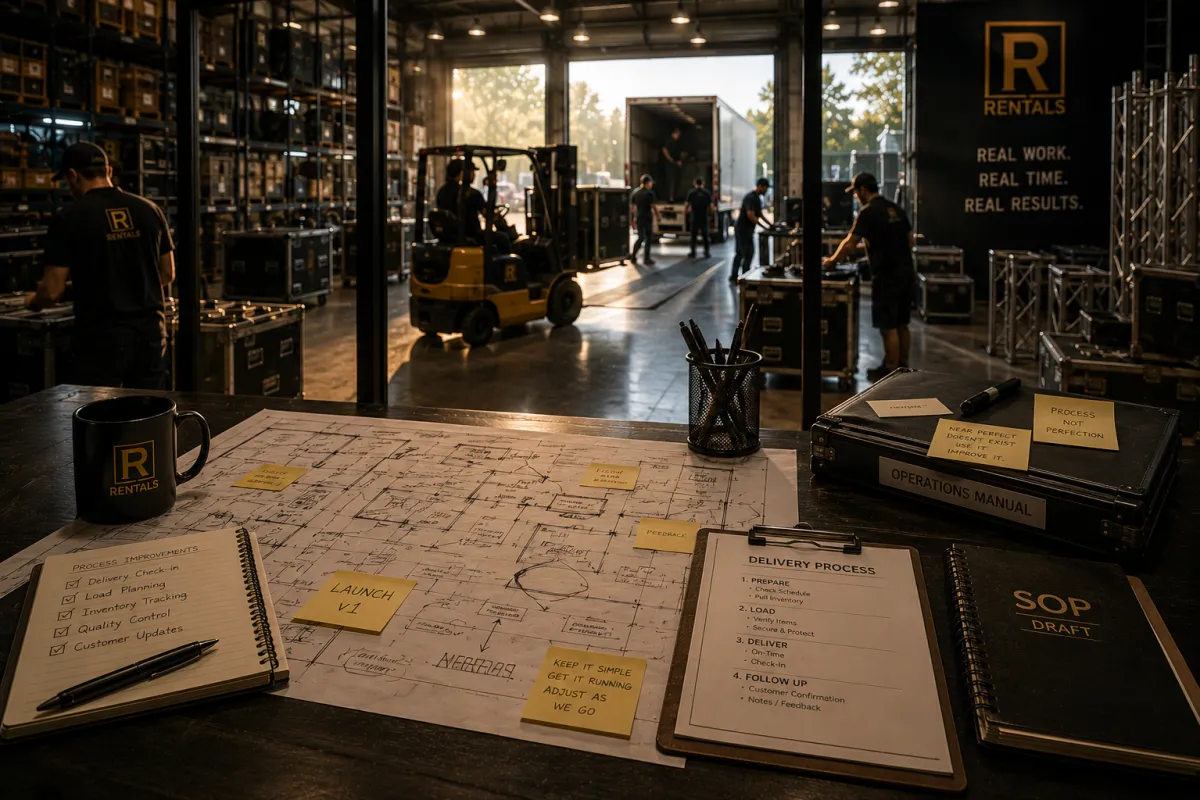
Move Before You Are Ready
The most dangerous place in business is not the starting line. It is the planning room where good ideas go to be refined until they no longer exist.
There is a version of this story that happens in almost every rental business. A process needs to be built. A system needs to be put in place. A training program needs to be created. Someone takes ownership of it, or tries to, and starts working on it. Weeks pass. Then months. The thing gets refined, reviewed, discussed, revised, refined again, and quietly moved to the back of the priority list because it still does not feel finished enough to roll out.
Meanwhile, the problem it was supposed to solve is still happening every day. And the team has started to notice that ideas get talked about but never land.
That gap between intention and execution is one of the most expensive gaps in business. And in most cases, it is not caused by laziness or lack of care. It is caused by a standard that does not exist in the real world: the idea that something needs to be finished before it can be used.
The lab-perfect trap
Most people know intuitively that overthinking kills momentum. But fewer recognize the specific mechanism by which it happens. When a business operates with the unspoken assumption that ideas need to be fully developed before they are deployed, the planning process expands to fill all available time. Every gap in the plan becomes a reason to keep refining. Every edge case becomes a reason to delay. The idea gets polished until it is theoretically complete and practically untested.
Then it meets reality. And reality does not care how long you spent in the planning room. A process that was built in isolation without the feedback of actual use will crack under real-world pressure in ways that no amount of refinement could have predicted. The very edge cases that delayed the launch are rarely the ones that surface first. The real issues are the ones you could not have seen until the thing was running.
This is the lab-perfect trap. The plan looks excellent. The rollout reveals what the plan missed. And because the team was told it was finished, the cracks feel like failures rather than what they actually are: normal, expected, and entirely workable feedback.
What happens when you move first
The alternative is not recklessness. It is a deliberate decision to prioritize real data over theoretical completeness. Launch the rough version. Run it. Watch where it breaks. Patch those specific points. Run it again. Over a few cycles of that, you have something better than anything you could have built in isolation — because it was shaped by the actual conditions it needs to operate in.
Software companies figured this out decades ago. The concept of shipping a minimum viable product, something functional enough to use and test but not necessarily polished, exists precisely because the feedback loop of real use is worth more than additional planning time. The same principle applies inside a rental business building a new delivery process, a new onboarding checklist, a new sales script, or a new scheduling system. Get it running at 70 percent. Let the remaining 30 percent be written by experience.
The lab-perfect approach
Months of planning before launch
Cracks under first real use
Team loses confidence in the rollout
Fixes feel like failures
Momentum stalls repeatedly
Real problems arrive as surprises
The move-first approach
Launch at 70% — run it immediately
Real feedback shapes the fix
Team sees progress and participates
Patches are expected, not embarrassing
Momentum builds with each cycle
Real problems surface and get solved fast
What your team learns when you build this way
There is a cultural dimension to this that is just as important as the operational one. When a business operates with a move-first, improve-as-you-go philosophy and communicates that philosophy openly to the team, something shifts in how people engage with new ideas.
They stop waiting for the finished version before offering feedback. They stop treating imperfection in a new process as a sign that leadership did not think it through. They start contributing because they understand that their experience running the thing is exactly the input that is supposed to shape it. The process belongs to everyone who uses it, not just the person who drafted it. That kind of engagement is nearly impossible to manufacture through planning alone. It is built through participation.
It also removes a specific kind of organizational frustration that builds when good ideas never land. Teams that watch initiative after initiative get refined into oblivion become skeptical of the next one. They stop investing in the process because they have learned, over time, that it probably will not go anywhere. Moving before you are ready breaks that pattern. It signals that execution is the priority, not the appearance of having figured everything out in advance.
A simple framework for building as you go
This does not require abandoning planning. It requires right-sizing it. The goal is to do enough planning to launch something functional, then let real-world use do the rest of the work. A simple three-phase approach works across almost any improvement initiative in a rental business.
Build to functional, not to finished
Define the core purpose of what you are building, identify the minimum it needs to do to be usable, and launch that version. Resist the pull to solve every edge case before the first use. Edge cases you have not seen yet are not worth designing for in advance.
Run it, watch it, patch it
Deploy the process or system into real use and observe what breaks. Collect feedback from the people closest to the work because they will see the gaps faster than anyone. Fix the specific points that are creating friction and run it again. Each cycle improves faster than the last because the fixes are targeted, not theoretical.
Neaten it up once you have enough data
After enough cycles, the thing has been shaped by real use and is ready to be documented properly, trained consistently, and held to a higher standard. At this point, the cleanup work is fast because you already know what works. You are not guessing. You are organizing what experience already taught you.
Why this saves time and not wastes it
The most common objection to moving before you are ready is that it creates rework. And it does, though it also creates less of it than the alternative. Rework on a process that has been running for three weeks in the real world is targeted and specific. Rework on a process that was built over three months in isolation is often structural, because the foundational assumptions turned out to be wrong. One costs you a few hours. The other costs you the three months you spent building something that needs to be rebuilt.
The math almost always favors launching early. The planning time you save at the front end compounds when real feedback sharpens the work faster than refinement alone ever could. And the team engagement that comes from participating in a live, improving system is worth more than any amount of polish applied before the first use.
Lastly, instead of reworking hypotheticals as a team, you can rework real world implementation instead. This enables the process to stay focused on the actual outcomes rather than things that may or may not happen.
Saves time
Real feedback fixes the right things fast. Months of planning often fixes the wrong things slowly.
Improves engagement
Teams that shape tools through use invest in them. Teams that receive finished tools often do not.
Reduces waste
You only build what real conditions require. Nothing gets over-engineered for problems that never materialize.
The permission you might need to hear
For many business owners and managers, the instinct to finish before launching runs deep. It feels responsible. It feels respectful of the team's time. It feels like the professional thing to do. But in practice, it often produces the opposite of those things: wasted time, disengaged teams, and ideas that never escape the planning stage.
Moving before you are ready is not a lower standard. It is a smarter one. It trusts the process of iteration over the illusion of completeness. It values real data over theoretical confidence. And it produces tools and systems that are forged by actual use rather than imagined in isolation.
The best version of any process is the one that has been run, broken, fixed, and run again. You cannot build that version in a planning room. You build it by starting.
So start. Launch the rough draft. Run the imperfect process. Deploy the 70 percent version. Then patch it, improve it, and let your team shape it into something that actually works in the world you operate in rather than the one you planned for.
The businesses that execute consistently are not the ones that think longer. They are the ones that start sooner and improve faster.


