How to Run Weekly Operations Meetings That Matter in Event & Equipment Rental Businesses
Most rental businesses do not have a communication problem. They have a communication system problem. One weekly meeting, run correctly, fixes more than most operators realize.
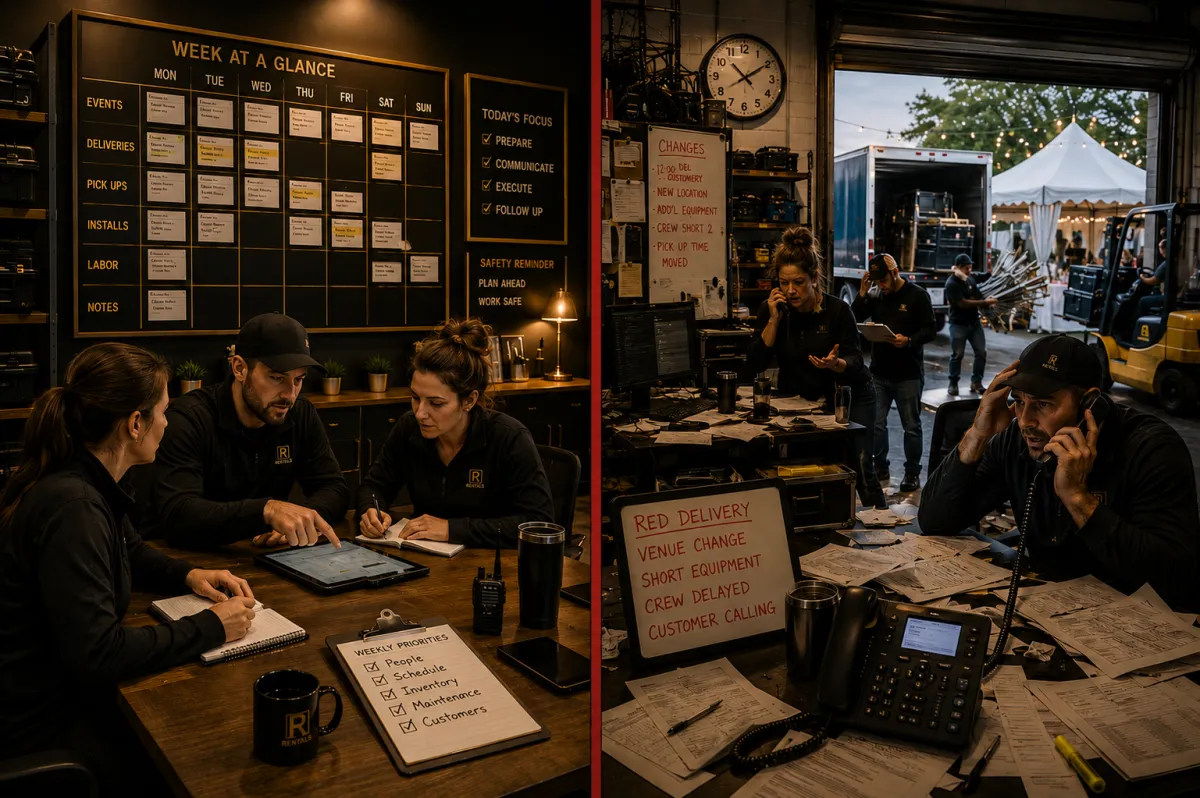
You can usually tell the operational health of a rental business by what happens when something goes wrong. A truck leaves late. A pull list is missing items. A customer calls because delivery timing changed. A tent install runs behind schedule. The warehouse blames sales. Sales blames dispatch. Dispatch blames the crew. Everyone feels busy. Nobody feels aligned.
Most rental businesses do not struggle because people do not care. They struggle because communication becomes fragmented as the business grows. Information lives in text messages, side conversations, sticky notes, and rushed exchanges while walking through the warehouse. A structured weekly operations meeting does not add complexity to that environment. It replaces the noise with clarity.
The problem is that most meetings are run poorly. They become long, unfocused conversations where the loudest voice dominates, the same problems repeat every week, and nobody leaves with clear ownership or next steps. A well-run weekly meeting should do the exact opposite. Here is a system that works across both event and equipment rental businesses.
01
Keep it short and ruthlessly structured
If your weekly operations meeting consistently runs too long, the structure is broken, not the content. Most effective operations meetings in rental businesses should land between 30 and 60 minutes depending on company size. The discipline to hold that window is what separates a meeting that sharpens the team from one that drains it.
The format does not need to be complicated. A simple six-part agenda covers everything that matters and nothing that does not.
Review KPIs and operational metrics
Review wins and immediate concerns
Review the upcoming operational schedule
Identify bottlenecks and constraints
Assign action items and ownership
Confirm priorities for the week
If a deeper conversation is needed on any issue, assign a separate follow-up discussion with only the relevant people. The weekly meeting is not the place to solve every problem. It is the place to surface them, assign them, and move on.
02
Start with numbers, not opinions
Feelings matter, but operational visibility matters more. Starting the meeting with a quick review of key numbers keeps the conversation grounded in reality rather than assumptions. The goal is not to overwhelm the team with data. The goal is to identify leading indicators before they become larger problems.
Weekly revenue booked
Delivery count
Labor hours and overtime
On-time delivery rate
Open maintenance tickets
Damage incidents
Quote conversion rate
Customer complaints or recoveries
Inventory utilization rates
AR or outstanding balances
The numbers tell a story if you know how to read them. Rising overtime hours may point to poor route planning or staffing gaps. Increasing damage incidents may reveal rushed warehouse procedures or insufficient training. Falling quote conversion rates may signal a breakdown in the handoff between sales and operations. Numbers create visibility. Visibility creates control.
03
Focus on the week ahead, not just the week behind
Many operations meetings spend the majority of their time discussing problems that already happened. Reviewing recent issues matters, but the primary purpose of the weekly meeting should be preparing for what is coming next. A backward-looking meeting manages the past. A forward-looking meeting prevents the future from repeating it.
The questions that should anchor the second half of every meeting are operational and prospective. What large events or deliveries are coming this week? Where are we most vulnerable? Do we have enough labor coverage? Are there inventory shortages or conflicts that need to be resolved before they become emergencies? Are any jobs unusually complex in ways that require advance coordination? Which customers need proactive communication before the week starts? Are maintenance priorities aligned with upcoming demand?
This forward-looking posture is what shifts a rental business from reactive management to proactive management. The teams that execute most consistently are not the ones that respond fastest to problems. They are the ones that see problems coming and eliminate them before the weekend.
04
Every action item needs one owner and one deadline
One of the most common operational killers in rental businesses is vague responsibility. Everyone assumes someone else is handling the issue, and the issue does not get handled. The discipline of assigning clear ownership to every action item discussed in the meeting is simple and non-negotiable.
The standard is one owner, one deadline, and one clearly expected outcome. Not a shared responsibility. Not "we should probably look at that." A named person with a specific date and a defined deliverable.
What clear ownership sounds like
Mike will reorganize the tent hardware section by Thursday.
Sarah will contact the venue regarding revised load-in timing by noon tomorrow.
Terry will finalize Saturday routes by Wednesday at 3 PM.
That level of specificity is what separates accountability from intention. Clarity reduces confusion. Ownership creates follow-through.
05
Build accountability without building fear
A strong operations meeting is not about surfacing mistakes so people can be blamed for them. If team members feel attacked every week, communication will shut down. Problems will become hidden instead of surfaced early, and the meeting will become something people dread rather than a tool they trust.
The purpose of accountability is operational improvement, not embarrassment. The best rental operators build environments where issues can be raised quickly and without defensiveness because everyone understands the shared goal: run cleaner operations and deliver a better customer experience.
That culture matters especially in rental because operational mistakes compound quickly. A problem that surfaces on Monday with enough time to correct it is a manageable situation. The same problem discovered on Friday afternoon is a crisis. Teams that feel safe raising issues early give you time to solve them. Teams that hide problems give you Saturday morning disasters.
06
If it is not documented, it disappears
The best-run weekly meeting in the world produces nothing if what was decided evaporates the moment people walk out of the room. Every meeting should end with a simple written record that captures the key priorities for the week, every assigned action item with its owner and deadline, and any major operational concerns that need ongoing visibility.
The tool does not matter much. A shared Google Doc, a recurring meeting template, a CRM task list, or a project management board all work. What matters is that the record exists, that it is accessible to the people who need it, and that it is reviewed at the start of the following week to close the accountability loop. If someone was supposed to complete a task by Thursday and it is now Monday, the meeting is where that gets addressed, not ignored.
Consistency is the only standard that counts. A documentation system used every week builds operational memory over time. One that gets skipped when things get busy is not a system at all.
Most rental businesses do not need more meetings. They need better ones. A weekly operations meeting that is structured, short, forward-looking, and tied to clear ownership creates alignment across sales, warehouse, dispatch, maintenance, and leadership in a single hour or less. It reduces surprises, improves accountability, and builds the kind of operational discipline that scales without adding chaos.
Once you've mastered this meeting's cadence and efficient delivery, take the same concepts to all other meetings.
The rental companies that consistently execute well are rarely relying on heroics. They are relying on systems. A missed detail on Monday often becomes a major customer issue by Saturday. The businesses that catch it on Monday are the ones running a meeting on Monday morning that was designed to find it.


