
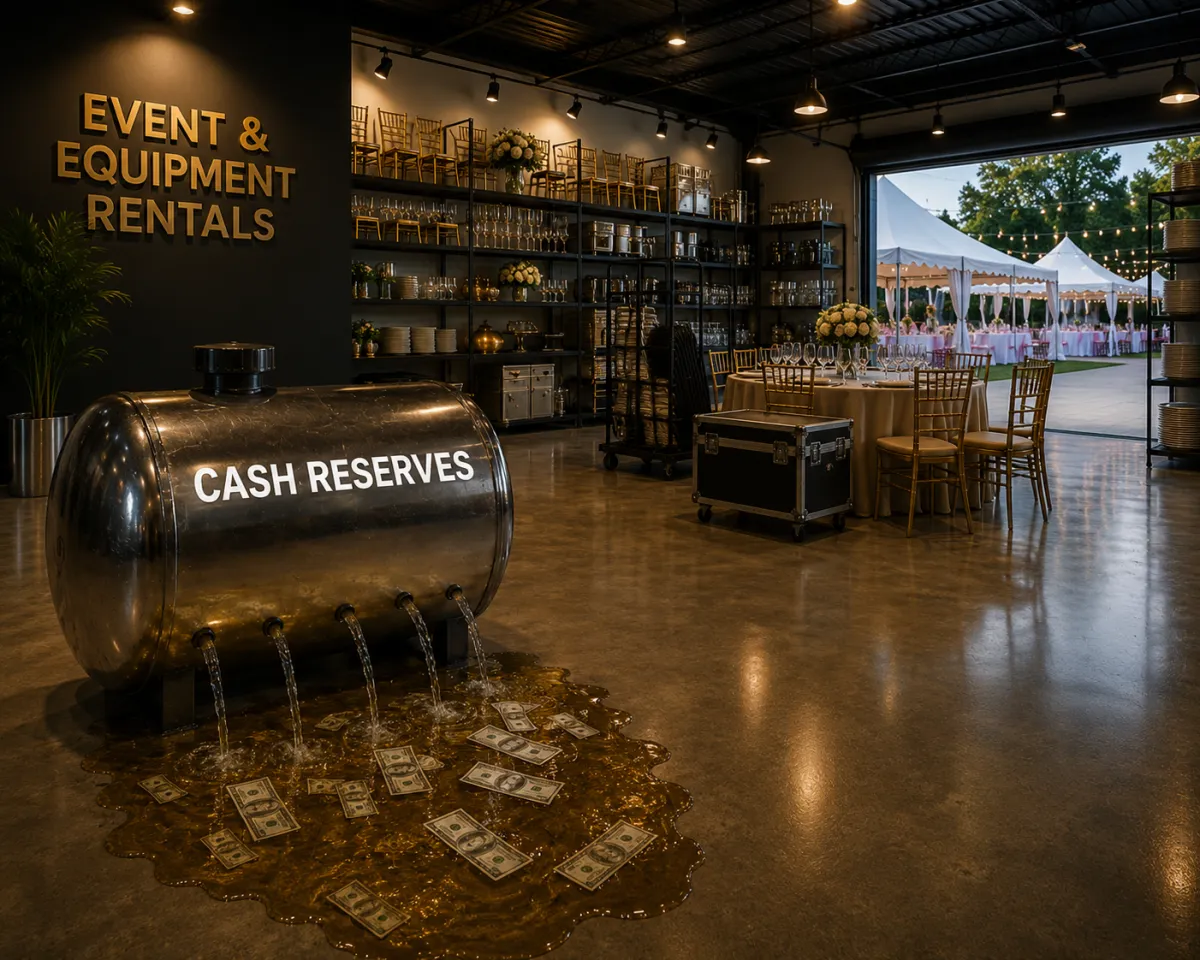
Why Equipment & Event Rental Businesses Struggle With Cash Flow
Revenue is not the same as cash. Many Equipment and Event rental businesses learn this the hard way with busy seasons, full trucks, and an empty bank account. Here is why it happens and what to do about it.
Cash flow is the most common pressure point in event and equipment rental businesses, and also the most misunderstood. Owners often assume that a cash problem is a revenue problem. If they could just book more events, rent more equipment, or land a bigger account, the pressure would ease. In many cases, that assumption is wrong, and acting on it alone makes the situation worse.
The reality is that rental businesses face structural cash challenges that are built into the business model itself. Understanding where those challenges come from is the first step toward building a system that controls them.
Why Rental Businesses Struggle With Cash
Most of these pressures apply across both event and equipment rental. A few show up more acutely in one or the other, but the underlying dynamics are the same: cash leaves before it returns, and the gap in between creates risk.
Seasonal revenue swings with fixed overhead
Busy seasons fund slow seasons, but most operators don't plan effectively enough for it. Payroll, rent, insurance, and debt payments do not pause when bookings do.
Slow invoicing and passive collections
Equipment goes out or an event ships, the invoice goes out late, and follow-up is passive. Days sales outstanding creeps up quietly and cash thins out.
Capital locked inside the fleet or inventory
Rental businesses are asset-heavy by design. Every dollar spent on a tent, forklift, or linen package is a dollar that is not liquid. Purchases made without modeling the cash impact create invisible strain.
Growth consumes cash before the revenue arrives
Adding inventory, hiring staff, and opening locations all require cash upfront. Fast growth can look excellent on paper while quietly draining the bank account.
No visibility into upcoming cash needs
Most operators manage cash by watching the bank balance. By the time the pressure shows up there, the decisions that caused it were made weeks or months earlier.
Customer payment terms that don't match vendor terms
Collecting final balances net 30 after the job while paying suppliers net 30 from the invoice date means the gap comes directly out of working capital.
Underpricing that erodes margin over time
Cash problems that look like a collections issue are sometimes a pricing issue in disguise. If margin is structurally thin, there is never enough cash regardless of volume.
Deposits and damage payouts that are slow to arrive
Security deposits held by venues, damage claims under review, and insurance reimbursements can tie up real cash for months while operating expenses continue.
Repair and maintenance costs that arrive in spikes
Older inventory generates unpredictable repair bills that hit all at once and are rarely budgeted for accurately. One major repair on a high-utilization asset can disrupt the month.
Debt service that does not match revenue timing
Loan payments on financed equipment are due monthly whether that equipment is rented or not. Operators who financed aggressively during growth feel this acutely when utilization dips.
3 Strategies to Stabilize Cash Flow
Understanding why cash is tight is only useful if it leads to a system that addresses it. Here are three strategies that give rental operators real control over their cash position.
01
Build and know your break-even
Most rental business owners have a general sense of whether the business is profitable, but far fewer know exactly what it costs to keep the doors open every single month before a single rental goes out or a single event ships. That number is your break-even, and not knowing it is one of the most dangerous positions an operator can be in.
Your break-even is the total of every fixed cost your business carries regardless of revenue: rent, payroll, insurance, debt payments, utilities, software subscriptions, vehicle costs, and any other obligation that arrives whether you are busy or not. When you know that number precisely, every decision changes. You know the minimum revenue required before the business becomes profitable each month. You know how many rentals, events, or job days it takes to cover your floor. You know, when a slow period arrives, exactly how far the gap is and how quickly you need to close it.
The break-even calculation is also the lens through which pricing decisions should be evaluated. If your total fixed costs are $60,000 per month and your average gross margin on a rental is 40 percent, you need $150,000 in monthly revenue just to break even before a dollar of profit is earned. That math should drive your minimum pricing floors, your seasonal planning, and your decisions about when it is safe to take on new overhead.
Seasonal rental businesses in particular need this number as a planning anchor. Knowing your break-even is what allows you to answer the most important off-season question: How long can we sustain this, and what does the recovery plan look like?
02
Understand and actively manage your cash gap
The cash gap is the distance between when your business spends money and when it gets paid back. In equipment rental, that gap often looks like this: you finance or purchase a piece of equipment, carry it on the yard, pay for its maintenance and insurance, and then wait for utilization to return that cash through rental revenue over months or years. In event rental, it looks like upfront purchases where inventory sits in a warehouse, deposits are collected weeks in advance, labor and logistics get immediately or shortly after, and sometimes final balances are paid long after the event is over.
Dell became famous for engineering a negative cash gap, collecting payment from customers before ever paying for the parts to build the product. Rental businesses cannot fully replicate that model, but the principle matters: the shorter the gap between spending cash and receiving it, the stronger and more stable your financial position.
There are concrete levers on both sides of the gap. On the collection side, shifting final balances from net 30 after an event to seven days before it, or requiring a larger upfront deposit on equipment rentals or shortening the billing cycle, can meaningfully reduce the time cash is outstanding without requiring any change to your pricing or your customer relationships. On the payment side, negotiating extended terms with your vendors, your linen supplier, your parts and equipment distributor, or your fuel provider means your obligations arrive later while your collections arrive sooner. That spread is free working capital.
For equipment rental specifically, every inventory purchase decision should begin with one question before asking whether you can afford it: how quickly does this asset return usable cash? An asset that generates strong revenue but takes four years to pay back its purchase cost ties up capital far longer than its utilization numbers suggest. Know the payback period on every major asset before you commit.
03
Run a rolling 13-week cash forecast with threshold zones
The single most powerful cash flow tool available to a rental operator costs nothing and requires no software beyond a spreadsheet. It is a rolling 13-week cash forecast, updated weekly, that answers one critical question: What will happen to our cash over the next 90 days?
Most operators manage cash reactively. They check the bank balance, make a judgment call, and move on. By the time a cash shortfall appears in that balance, the problem is already well underway. A 13-week forecast creates a 90-day window of visibility so that pressure can be seen and addressed before it becomes a crisis. Every week, you project your expected cash in from deposits, final payments, and AR collections, and your expected cash out from payroll, rent, fuel, repairs, inventory purchases, and debt payments. The result is a rolling picture of where your cash position is headed, not where it is today.
The forecast becomes most powerful when paired with a minimum safe cash buffer and a set of predefined threshold zones. Your minimum buffer is calculated simply: your average weekly fixed cash out multiplied by a safety period of your choosing, typically four to six weeks at a minimum. If your average fixed weekly outflow is $18,000 and you choose a six-week safety window, your minimum reserve target is $108,000. That number is not a balance to spend down to. It is the floor below which decisions become urgent.
From that floor, define three zones and the actions that correspond to each:
Green Zone
Healthy reserves above your buffer. Stay disciplined, avoid complacency, and invest strategically without eroding the floor.
Yellow Zone
Reserves trending toward the buffer. Pause non-essential spending, run targeted promotions, accelerate collections, and incentivize early payment.
Red Zone
Reserves below the floor. Take decisive action: sell underperforming inventory, cut all non-critical spending, centralize approvals, and move aggressively on AR.
The threshold zones do something that most cash management approaches do not: they remove panic from the decision-making process. When your cash dips, you are not improvising. You already know what to do because you built the plan before the pressure arrived. That is the difference between a rental business that survives a difficult quarter and one that does not.
Cash flow is not a problem you solve once. It is a system you build and maintain. The rental businesses with the strongest financial positions are not always the ones with the highest revenue. They are the ones that know their break-even, understand what drives their cash gap, and can see 90 days ahead clearly enough to act before pressure becomes a crisis.
Most of the tools described here require no outside investment. They require honesty about the numbers, discipline to track them weekly, and a plan for what to do when the forecast shows something you do not want to see.


