
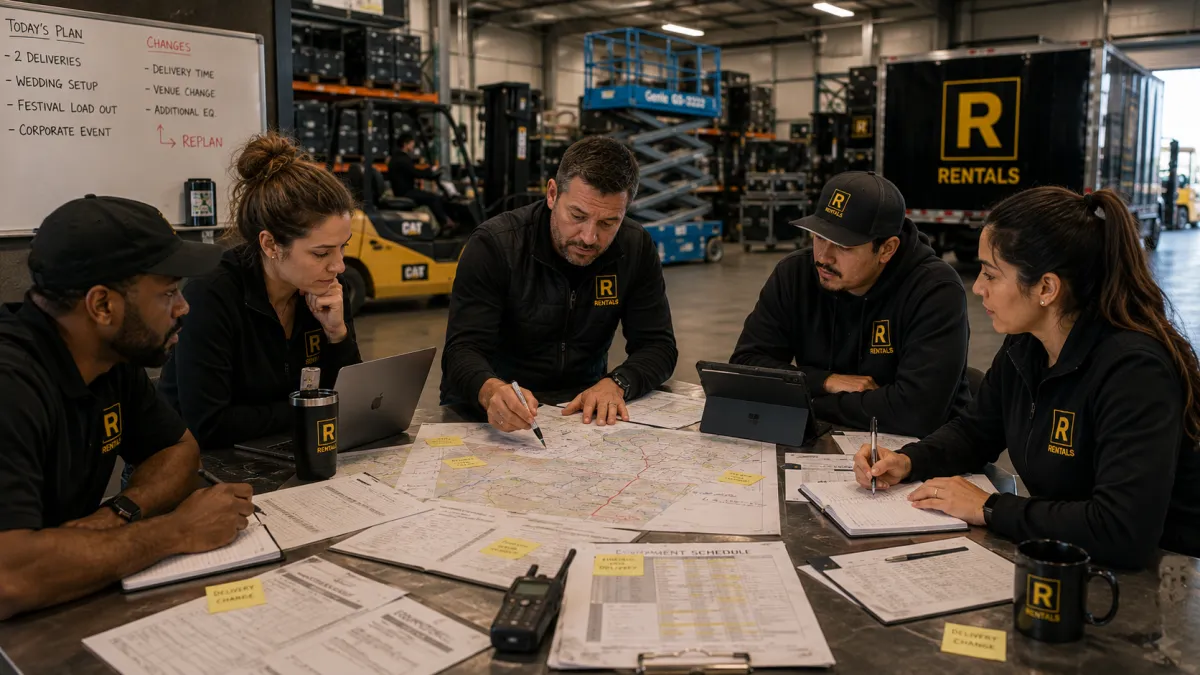
10 Agile Principles Every Event and Equipment Rental Business Owner Should Use
Agile was built for software teams. But the principles underneath it, like how to iterate fast, respond to feedback, work in short cycles, and adapt without losing direction, apply just as powerfully on a warehouse floor or a job site.
Agile methodology was formalized by software developers in 2001. The core idea was simple: stop building large, finished products in isolation and then discovering they do not match what users actually need. Instead, build in short cycles, get real feedback early, adjust based on what you learn, and repeat. The result is faster improvement, less wasted effort, and products that actually fit the people using them.
You do not run a software company. But you run a business that faces constant uncertainty, rapid change, real-time feedback from customers and crews, and the need to make decisions without complete information. Sound familiar? The specific context is different. The underlying challenge is identical. Here is what Agile has to say about it.
01
Plans are useful. Rigid attachment to them is expensive.
The Agile Manifesto does not say plans are bad. It says that when real conditions diverge from the plan, the conditions win. A plan made in January for a peak season in June is based on assumptions about staffing levels, inventory availability, customer demand, and market conditions that may all look different by the time June arrives. The rental business that executes the January plan regardless of what June is actually showing is spending energy in the wrong direction.
The more valuable practice is to plan with clear intentions and then review those plans regularly against what is actually happening. Weekly operational reviews, rolling cash forecasts, and monthly strategy check-ins are not signs that the original plan failed. Rather, they are the mechanism that keeps the business pointed in the right direction as conditions change. The goal is not to avoid planning. It is to avoid the rigidity that makes a plan more important than the reality it was trying to describe.
02
Operate in focused cycles, not endless open-ended initiatives
Agile teams work in sprints that are short, focused cycles of two to four weeks with a defined goal, a review at the end, and a reset before the next cycle begins. The benefit is clarity: everyone knows what the priority is this sprint, what done looks like, and when the team will step back to evaluate progress. Compare that to how most rental businesses manage improvement initiatives: an idea gets raised in a meeting, someone is loosely assigned to it, months pass, the original urgency fades, and the initiative either disappears or gets rediscovered at the next annual planning session.
Applying the sprint concept in rental does not require Agile software or a scrum board. It requires defining a specific operational improvement goal, assigning clear ownership, setting a completion date of two to four weeks out, and reviewing the outcome. Did the new pull checklist reduce staging errors? Did the updated rate structure improve margin on the target category? Did the new customer follow-up process increase review volume? Small, completed cycles of improvement compound into meaningful operational change in a way that ongoing, open-ended initiatives rarely do.
03
Move before it is perfect then improve from real use
Agile teams ship working software frequently rather than waiting for a finished product. The logic is that a 70 percent solution in users' hands generates more useful feedback than a 100 percent solution still in development. The gap between what the team thought users needed and what users actually need only becomes visible when the product is in use.
In rental, this translates directly into the discipline of launching processes, systems, and service changes before they are fully polished. A new customer onboarding communication that goes out in rough form and gets refined based on what customers ask about afterward is more useful than a communication that sits in draft for three months while someone perfects the wording. A new equipment inspection checklist that is used for two weeks and then revised based on what the techs encounter in real conditions is better than one that was designed entirely from a conference room. Launch the working version. Let real use write the next draft.
04
Stay in active conversation with customers and not just at booking and billing
Agile development keeps the customer inside the process throughout, not just at the requirements stage and the delivery stage. The customer's feedback shapes every sprint review. What they actually use, what frustrates them, and what they keep asking for is treated as primary input rather than post-launch commentary.
In rental, this means building active customer feedback loops into the operating system rather than collecting feedback passively after the fact. Post-rental surveys, direct check-in calls after complex jobs, quarterly conversations with top accounts about upcoming needs and recurring frustrations. These are not customer service niceties; they are intelligence gathering that shapes inventory decisions, process improvements, service standards, and competitive positioning. The rental businesses that improve fastest are the ones that treat their best customers as collaborators in building a better service, not just recipients of what was already decided.
05
Build teams capable of solving problems without waiting for permission
Agile teams are designed to be self-organizing. They are given a clear goal and the authority to figure out how to reach it. The team decides how to divide the work, how to handle obstacles, and how to adapt when conditions change. The manager sets direction and removes barriers. The team executes without needing a decision at every step.
This maps directly onto the founder bottleneck problem in many rental businesses. A warehouse crew that waits for the owner to make every inventory substitution call, a counter team that escalates every pricing question upward, and a delivery driver who calls back to base before handling any customer complaint are all operating in the opposite of a self-organizing model. Building the clarity, decision rights, and training that allow a rental team to handle the work within defined boundaries without constant owner input is not a management style preference. It is the operational structure that makes scale possible.
An interesting anecdote from the book Chief Joy Officer, describes how the owner of the business learned of a significant issue that his team handled extraordinarily well. At first he was frustrated that he was hearing about it weeks later, but then he realized that he was no longer the bottleneck, nor the only decision maker, and that he had built a stellar and empowered team for this reason.
06
Build in structured pauses to ask what is working and what is not
Every Agile sprint ends with a retrospective: a structured conversation where the team asks three questions. What went well? What did not go well? What do we change next sprint? This is not a blame session. It is an improvement mechanism built into the rhythm of the work, not bolted on as an afterthought when something goes badly wrong.
Most rental businesses have the equivalent of a retrospective only when something breaks badly enough to force a conversation. A missed delivery triggers a meeting. A major customer complaint produces a debrief. An equipment failure causes a process review. Those conversations are reactive by design. The Agile version makes them proactive and regular. A weekly or bi-weekly after-action on recent jobs, reservations, or client visits, builds operational improvement into the cadence rather than waiting for a crisis to force it. Small, consistent improvements made at the sprint level compound into meaningful operational gains over a season.
07
Ruthlessly remove anything that consumes effort without creating value
Lean and Agile share a foundational commitment to waste elimination. In Agile, waste is anything that consumes team capacity without contributing to working output: unnecessary meetings, redundant approvals, features nobody uses, documentation nobody reads. The discipline is to identify those activities and remove or simplify them so that energy goes toward what actually matters.
In rental, waste accumulates invisibly over time. Approval steps that were added after a mistake years ago and never removed. Duplicate data entry into two systems that do not talk to each other. Checklists so long that crews skip them entirely. Reports that someone asked for once and that now run automatically every week into an inbox nobody checks. Each of these consumes time without producing value. Applying an Agile lens means asking regularly: does this step, this meeting, this report, this process make the work easier and the output better? If not, it is waste, and waste is not neutral. It is a direct cost to the business in time, attention, and energy that could have gone somewhere else.
08
The ability to adapt faster than competitors is a genuine edge
One of the most counterintuitive claims in the Agile Manifesto is that welcoming changing requirements, even late in development, is not a liability. It is an advantage. A team that can incorporate new information and adjust course quickly is more competitive than one that is locked into what was decided six months ago, regardless of what has changed since.
In rental, the business that can respond quickly to a shift in customer demand, a gap in the competitive landscape, or an unexpected operational challenge is always in a stronger position than one that requires months of planning before it can move. That speed of adaptation is not accidental. It comes from having clear decision rights, short feedback loops, a team empowered to act, and a leadership culture that treats a course correction as a sign of intelligence rather than a sign of failure. Agility is a competitive position, not just an operating style.
09
You do not have to rebuild the whole operation; improve one thing at a time
Agile teams do not try to deliver the entire product at once. They deliver a working, valuable increment and then build on it. This approach prevents the failure mode where a massive initiative is built in isolation, launched all at once, and discovered not to work the way anyone expected.
The parallel in rental is the owner who is waiting to implement a new customer communication system, a new inventory management process, or a new sales training program until it is fully designed and ready to roll out company-wide. That moment rarely comes. The Agile alternative is to pick the highest-value piece of the improvement, implement that one piece for one team, one branch, or one job type, and learn from what happens before expanding it. One well-executed improvement that is actually running beats ten planned improvements that are still in development. Small, real increments of progress build momentum in a way that large, aspirational initiatives rarely do.
10
The most powerful thing you can do is focus on less
One of the Agile Manifesto's twelve principles states that simplicity, which is the art of maximizing the amount of work not done, is essential. This sounds like doing less. It is actually about doing the right things and having the discipline to stop doing everything else. Agile teams regularly evaluate their backlog and eliminate work that no longer serves the goal. The discipline is not in adding priorities. It is in removing them.
For rental business owners, this principle is both the most valuable and the hardest to act on. Most operators carry a mental backlog of dozens of things they want to improve, add, launch, or fix. The temptation is to pursue as many of them as possible simultaneously. The Agile evidence, and the evidence from rental businesses that scale successfully, points in the opposite direction. Three initiatives completed this quarter produce more value than ten initiatives at 30 percent progress. The work you choose not to do is not wasted. It is the focused attention you gave to the work that actually moved the business forward.
Agile was not built for rental. But the problems it was built to solve, like how to operate effectively under uncertainty, how to get useful feedback faster, how to build a team that adapts without losing direction, and how to stop wasting effort on things that do not move the business forward, are problems that rental operators face every single day of their operating year.
You do not need a scrum board or a sprint planning session to apply these principles. You need the discipline to work in focused cycles, the bravery to launch before perfection, the systems to collect and act on real feedback, and the judgment to focus on fewer things more completely. That is what Agile teaches software teams. And it is exactly what the best rental businesses are already doing, whether they have ever heard the word Agile or not.


