
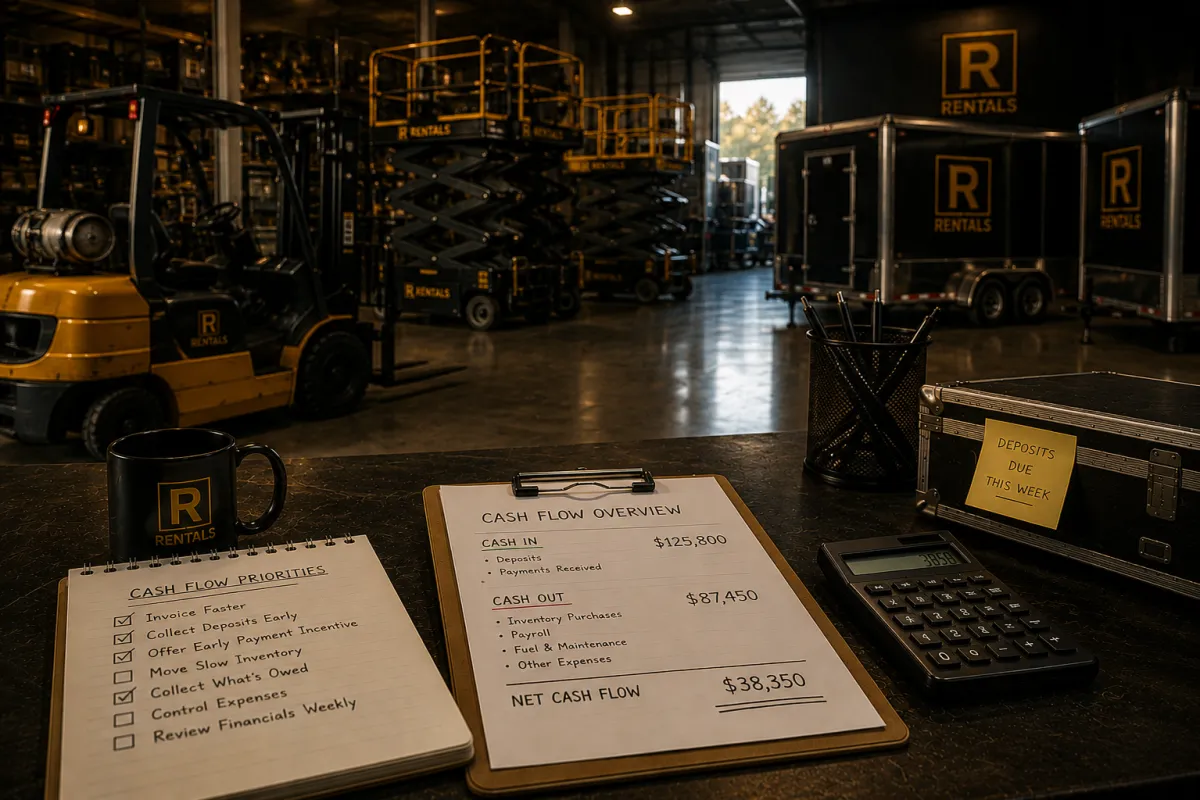
Equipment Rental Cash Flow Management: 7 Ways to Improve Cash Flow
Your equipment can be out on rent while your bank balance is running low. Payroll, repairs, and fleet payments come due on fixed dates, but customer payments do not always arrive in time to cover them.
Improving equipment rental cash flow starts with understanding that timing gap—and checking whether low margins, fleet spending, or debt payments are making it worse. More bookings can help, but they can also create additional delivery, labor, and maintenance costs before you collect payment.
This guide explains how to forecast your cash position, collect payments sooner, and make better spending decisions without relying solely on more rental bookings.
What is equipment rental cash flow?
Equipment rental cash flow is the movement of money into and out of your business during a specific period. Customer payments bring cash in; payroll, suppliers, equipment purchases, and debt payments take cash out. Borrowing and asset sales can also bring in cash, but they should be tracked separately from customer collections.
Cash flow management means planning those movements so you can meet obligations when they fall due. It requires more than checking today's bank balance.
Measure | What it tells you | What it does not establish |
|---|---|---|
Revenue | Income earned during the period. | Whether customers have paid. |
Profit | Revenue remaining after the relevant expenses. | Whether cash is available for every upcoming payment. |
Cash flow | Money actually received and paid. | Whether an increase came from sustainable rental operations or a loan or asset sale. |
Rental fleet utilization | How much equipment is rented, or how much rental revenue it generates relative to its cost. | Whether that revenue has been collected or rentals are sufficiently profitable. |
A profitable business can still face a cash shortage. Depreciation reduces accounting profit without creating a current cash payment. Buying equipment and repaying loan principal affect cash differently from expenses on an income statement. The SEC's guide to financial statements explains these distinctions.
For more on the underlying causes, read why rental businesses struggle with cash flow.
Find the cash flow problem before choosing the fix
A delayed customer payment and an unprofitable rental category can both leave you short of cash. They need different responses. Use this starting checklist to decide where to investigate.
What you notice | What to check first |
|---|---|
The fleet is busy, but cash is tight. | Unbilled rentals, overdue invoices, and the timing of customer payments. |
Cash pressure started after new equipment arrived. | Down payments, financing obligations, and the time needed for new assets to earn revenue. |
Major repairs repeatedly disrupt payroll or supplier payments. | Maintenance plans, repair history, and available reserves. |
The same shortage appears every slow season. | Seasonal collections, fixed payments, and the cash retained during busier months. |
Even prompt collections do not cover the bills. | Rental margins, overhead, debt payments, and owner withdrawals. |
Build a 13-week equipment rental cash flow forecast
A rolling 13-week forecast estimates your weekly cash receipts, payments, and ending balance over roughly one quarter. Update it each week, replace estimates with actual results, and add another week to the end. BDC recommends this approach for improving short-term cash visibility in its cash flow planning guide.
Start with cash you can actually use. Schedule customer receipts by realistic payment dates, not simply invoice dates. List operating payments, debt service, taxes, planned equipment spending, and owner distributions separately. Show loan proceeds and asset sales on their own lines if they are expected.
Cash movement | Week 1 | Week 2 | Week 3 |
|---|---|---|---|
Opening cash | $40,000 | $41,000 | $24,000 |
Customer collections | $25,000 | $30,000 | $28,000 |
Operating payments | ($18,000) | ($24,000) | ($22,000) |
Loan principal and interest | ($6,000) | ($6,000) | ($6,000) |
Tax payments | $0 | ($5,000) | $0 |
Equipment down payment | $0 | ($12,000) | $0 |
Closing cash | $41,000 | $24,000 | $24,000 |
In this example, a $15,000 receipt moving from week 2 to week 4 would reduce the closing balance in weeks 2 and 3 to $9,000. If the owner's chosen minimum cash buffer were $15,000, that delay would trigger action before the shortage arrived. That buffer is an example, not a recommended amount for every business.
Test a slower-collections scenario and a repair-cost scenario alongside your base forecast. For seasonal preparation, see these strategies to protect cash during the slow season.
7 ways to improve equipment rental cash flow
1. Shorten the gap between rental activity and invoicing
Invoice accurately and on the schedule agreed with the customer. For short rentals, complete the return checks and issue the final invoice promptly. For long rentals, bill at the agreed intervals while equipment remains on rent; do not wait months for the unit to return.
Check what customers need to approve payment: a purchase order, job number, delivery confirmation, or submission through a billing portal. An invoice sent quickly but rejected for missing information can still delay cash.
For example, billing a completed rental 20 days earlier could move the payment due date 20 days earlier when terms run from the invoice date. It does not guarantee the customer will pay sooner. Track actual receipt dates as well as invoice dates.
Keep billing frequency separate from pricing. Moving from calendar-month billing to four-week billing does not automatically create more revenue. Any change to the charge per period needs clear terms and customer agreement.
Start here: Review completed rentals that have not been invoiced and active rentals past their agreed billing date. Give each exception an owner and a resolution date.
2. Turn accounts receivable into a weekly operating routine
Accounts receivable (AR) is money customers owe you. Review the aging report weekly, identify overdue balances, and record both the reason for delay and the next action.
Separate an unpaid invoice from a disputed invoice. Missing paperwork, incorrect charges, and genuine payment difficulty need different responses. Confirm who approves each large account's invoices and how payment dates are determined.
A sample follow-up sequence is an email shortly after the due date, a direct call if it remains unpaid, and an escalation to the person authorized to review credit terms. Set the intervals and any restrictions on future rentals according to your agreements and customer risk—not a universal timetable.
For new or higher-risk accounts, consider deposits, credit limits, or authorized payment methods where appropriate. Explain these requirements before accepting the rental. A card on file is not the same as permission to charge it for any amount.
Start here: List your largest overdue balances with the contact, dispute status, promised payment date, and next follow-up. Reflect realistic receipts in the forecast.
3. Review underperforming equipment before it absorbs more cash
Equipment that rarely rents can tie up capital while still creating financing, insurance, storage, and maintenance obligations. But a low equipment rental utilization rate alone is not enough to justify selling it.
Review demand by equipment category and season. Check rental revenue, repair spending, downtime, remaining debt, resale value, and whether the unit supports profitable rentals of other equipment.
Time utilization measures how often equipment is on rent over a defined period. Dollar utilization compares rental revenue with equipment cost. Both help assess performance, but neither measures cash collected or net profit. Use consistent definitions across reports; InTempo explains the distinction between time and dollar utilization.
If the problem is slow repairs, poor availability data, or missed rental opportunities, first consider how to improve equipment rental utilization. If demand is persistently weak and the asset no longer fits your fleet, a planned sale may be more appropriate.
Estimate the cash you would actually retain after any required lender payoff, selling costs, and applicable taxes. Confirm release requirements with the lender. A sale can release cash once; it does not create recurring rental income.
Start here: Select a few consistently weak performers and document a decision for each: improve availability, reposition, keep for a defined reason, or investigate a sale.
4. Review fleet financing against your cash cycle
Financing should be evaluated against the cash the fleet can realistically generate, including slower months. A smaller monthly payment may ease immediate pressure, but it is not necessarily a cheaper loan.
Prepare a schedule showing each asset's balance, interest rate, payment, maturity, and any balloon payment. Ask your lender about available options before a projected shortage becomes urgent. Refinancing or extending repayment may help in some circumstances; BDC outlines common debt refinancing approaches.
Compare the existing and proposed arrangements using monthly payments, fees, penalties, total remaining payments, collateral requirements, and the equipment's useful life. Availability and suitability depend on the lender and your business.
A sale-leaseback may release equity while retaining access to equipment, but it adds lease commitments and changes ownership. Review the full cost, contract, and accounting or tax consequences with qualified advisers. Do not treat it as free working capital.
Start here: Identify the weeks when debt payments put the forecast under pressure. Bring that forecast and your loan schedule to the lender.
5. Plan repair cash before the repair bill arrives
A maintenance reserve is cash deliberately set aside for future work. It can reduce the disruption caused by a major repair, but it does not create extra cash or guarantee that every repair will be covered.
Build the reserve plan from your repair history, fleet age, warranty coverage, known upcoming work, and the consequence of a critical unit failing. Historical averages are a starting point; an aging fleet or a scheduled overhaul can change the requirement.
For illustration, reserving $2,000 a month would accumulate $24,000 over a year if nothing were spent from it. That is simple planning arithmetic, not a recommended reserve for every fleet.
If you move money between your own bank accounts, do not count the transfer as a new business expense or a reduction in total cash. Show separately how much cash remains available for other obligations. Record the actual repair payment when it occurs.
Follow manufacturer maintenance and inspection requirements, including operating hours, calendar intervals, and conditions of use. Do not defer safety-critical work to protect a short-term cash balance.
Start here: List expected major repairs for the coming quarter, estimate their timing and cost, and compare them with the cash already reserved.
6. Put equipment purchases through a cash forecast
A purchase can look attractive on projected revenue and still create a cash shortage before it pays off. Forecast the down payment, delivery and setup costs, financing payments, and operating costs alongside realistic collections from the new unit.
Separate essential replacements from expansion purchases. Ask whether you can meet demand with the current fleet, whether demand is seasonal, and how long the new equipment may wait before its first paid rental.
When practical, compare buying with an approved transfer between branches or a properly arranged rental from another operator. Include transport, insurance, contract restrictions, and the actual rental margin in the comparison.
Use a slower-demand scenario rather than relying only on peak-season assumptions. If the purchase pushes cash below your chosen buffer, revisit its timing, structure, or necessity. This guide to when to expand inventory versus improve utilization can help frame the decision.
Start here: Add each planned purchase and replacement to the 13-week forecast, then check its longer-term payments in your annual plan.
7. Renegotiate vendor terms and review recurring costs
Supplier terms and recurring expenses affect both how much cash leaves the business and when it leaves. Review fuel, parts, tires, insurance, software, processing fees, transport, and other regular charges.
Ask suppliers whether payment dates, order frequency, or volume pricing can better fit your operations. An agreed extension may reduce a timing gap; simply paying late can create fees, supply interruptions, or relationship problems.
Review at least 90 days of transactions and check annual renewals separately. Look for unused subscriptions, duplicate tools, avoidable fees, and services that no longer match your needs. Compare total cost and switching disruption, not just the advertised price.
For example, reducing an effective processing rate by 0.5 percentage points on $400,000 of eligible annual card payments would save $2,000 before any added fees or other changes. This is an illustration, not a quoted rate or promised saving.
Do not cut necessary insurance, inspections, maintenance, or data security just to make one month's cash position look better.
Start here: Assign an owner and review date to your largest recurring costs. Record whether each change reduces total spending, changes payment timing, or both.
Make equipment rental cash flow management a weekly habit
A forecast is only useful if someone updates it and acts on the changes. Give each cash issue an owner, a deadline, and a follow-up date.
Use a focused weekly operations meeting to connect finance, the counter, the shop, and the person approving fleet spending. Keep detailed account discussions with the appropriate team members.
If the same cash shortages keep returning, equipment rental business coaching can help you connect fleet decisions, operating processes, and team accountability.
Start with the biggest confirmed pressure in your forecast. Fix the billing backlog, follow up on the overdue account, or revisit the purchase that creates a shortfall. Then check whether cash actually arrives sooner or spending falls as expected.
Frequently Asked Questions
Why can a profitable equipment rental business run short of cash?
Profit and cash follow different timing and accounting rules. Customers may not have paid recorded revenue, while equipment purchases, loan principal, or owner withdrawals consume cash. A profit report and a cash forecast answer different questions; use both.
Does higher equipment rental utilization always improve cash flow?
No. Higher utilization can increase revenue, but discounts, delivery costs, repair spending, and delayed payments can offset the benefit. Review time utilization, dollar utilization, margins, and collections together before assuming a busier fleet means more available cash.
Does four-week billing increase revenue by 8%?
Not automatically. Thirteen equal charges total about 8.3% more than twelve equal charges. That comparison assumes the same amount per charge and continuous billing over the compared periods. Changing invoice frequency alone does not change earned revenue; actual results depend on pricing, rental duration, partial-period rules, and the contract.
How much cash should an equipment rental business keep in reserve?
There is no single amount that fits every fleet. Set a target using unavoidable payments, seasonal demand, customer payment behavior, repair exposure, and access to committed funding. Test whether the business could meet obligations if collections slowed or a major unit failed.
Should you sell equipment to solve a cash shortage?
Possibly, when the asset has weak future demand or no longer fits the fleet and the net sale proceeds would help. Compare the cash retained after costs and required debt payoff with the future contribution you would lose. Selling a productive unit to cover recurring losses may postpone a deeper problem.
What if better collections still do not cover the bills?
Review margins, overhead, fleet investment, and debt service. A persistent cash deficit may require changes to pricing, capacity, spending, or financing—not just faster invoicing. If you expect to miss payroll, taxes, or debt payments, involve your accountant and relevant advisers promptly.


