
Finding $240,000/yr in an Event Rental Business
How a luxury event rental company improved profitability that was hiding inside a five-million-dollar business.
The Only Consultant Dedicated to Helping Equipment & Event Rental Companies Grow Profitability


IMPROVEMENTS AT A GLANCE
THE SITUATION
The company was a single-location luxury event rental business that carried linens, tabletop, custom furniture, tables, chairs, and full-service delivery for weddings and high-end events across the country. Revenue was approaching five million dollars a year, the calendar was full, and the team was busy.
Busy enough that the problems were easy to spot, but hard to slow down and fix. The business was growing, so the pain felt like the price of growth rather than waste that could be fixed. The owner knew better. They knew the operation had accumulated years of inefficiencies with vendor contracts that had never been renegotiated, a labor model that was bleeding money on every event that traveled more than an hour from the yard, and recurring expenses that nobody was actively watching. They wanted someone who had run operations in this industry to come in, see what they couldn't see from inside it, and fix what was fixable.
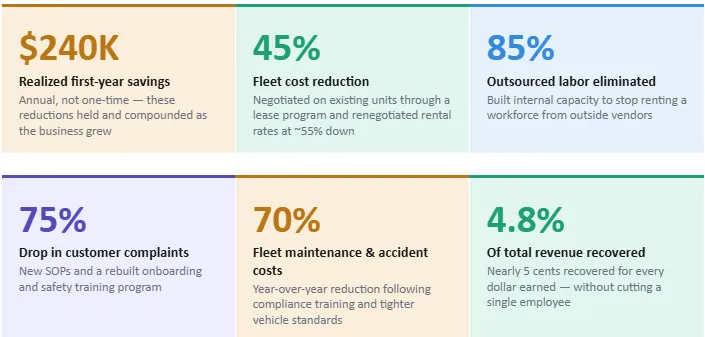
What followed was a structured three-phase engagement that produced $240,000 in realized annual savings in the first year alone while also rebuilding the operational foundation the business needed to sustain the growth it was already pursuing. Not only did we achieve these savings, but these would continue to benefit the organization for years to come.
THE WORK
PHASE 1 Fleet and Vendor Contracts
The fleet was the first to be addressed because it was the most fixable. The company was running up to thirty units at a time with a combination of leased and rented vehicles, while paying rates that reflected the top of the market with normal consumers, not what a well-positioned buyer could negotiate.
Two units were moved into a lease structure that took advantage of a specific program the vendor was running at the time. The rental rates on the remaining fleet were renegotiated significantly. The final reduction on those rates came in at fifty-five percent. Combined, the fleet changes cut targeted contract costs by forty-five percent.
Recurring vendor spend across the business got the same treatment. Subscriptions, service agreements, and supplier relationships were reviewed line by line. The question for each one was the same: is this being used, is it being used at the right price, and is anyone actually watching it? The answers were often no, no, and no.
No vehicles were cut. No service levels changed. The same fleet, doing the same work, for significantly less.
PHASE 2 Labor — The Biggest Cost, and the Biggest Opportunity
Labor is almost always the largest single cost in an event rental business. This one was no different. The instinct when labor costs are high is to look at headcount. That was the wrong place to look here.
The issue wasn't how many people were on the team. It was how the team was deployed. Events were traveling as far as eight to ten hours from the yard. Crew members were being paid to sit in a truck for the better part of a day, in each direction, for events that could have been staffed by qualified people who lived near the job site. One to two hours out was common. Three to four hours was regular. Eight to ten hours happened every so often.
The model shifted. For sites at meaningful distances from the yard, workers were hired locally with people who lived near the venues and job sites, brought in specifically to work those events. Paid travel time dropped. The crew that stayed home wasn't burning overtime covering the gap. Drive time that was previously on the clock stopped showing up on the paycheck.
Scheduling got tighter at the same time. Adding targeted headcount in the right places reduced peak-season overtime rather than creating more of it. Time-and-attendance tracking was tightened to stop avoidable premium pay from slipping through. None of this required a layoff. It required the discipline to look at where hours were actually going and match the staffing model to the work.
The result of Phases 1 & 2: $240,000 in reduced operational costs in the first year. Realized, annual, and compounding as volume grew.
PHASE 3 Training, Standards, and Internal Capacity
The savings got the attention. The operational rebuild underneath them is what made them last.
The team went through safety and compliance training alongside a rebuilt onboarding program. This wasn't a compliance checkbox. It was a direct response to a pattern of preventable issues, such as customer complaints, vehicle incidents, and the cost of fixing both after the fact. When people understand what they're doing and why the standard matters, they make better decisions on the road and on-site without someone looking over their shoulder.
Standard operating procedures were written and implemented across the core operational functions. The SOPs didn't replace judgment; they just gave the team a consistent baseline so that the quality of an event didn't depend on which crew member happened to be leading it that day.
The outsourced labor spend tells the rest of the story. The business had been supplementing its own workforce by renting labor from outside vendors, which was a sign that internal capacity wasn't where it needed to be to handle demand. Eighty-five percent of that spend was eliminated. Not because the work went away. Because the internal team was now built, trained, and scheduled in a way that could actually carry it.
Fleet maintenance and accident costs fell 70% year over year. Customer issues and complaints dropped 75%. The savings held because the operation underneath them held.
WHAT CHANGED
The $240,000 in first-year savings represents nearly five percent of total revenue, which was almost five cents recovered for every dollar earned. In a five-million-dollar business operating on typical event rental margins, that is meaningful. In a business growing toward ten million, those annual savings compound without additional intervention because the structural changes that produced them: the renegotiated contracts, the on-site labor model, the scheduling discipline, the reduced outsourced spend. All those scale with the business rather than requiring rework at each new revenue level.
The operational improvements are harder to put a dollar figure on but arguably more durable. A seventy-five percent reduction in customer complaints changes how planners and venues talk about the company. A seventy percent drop in fleet maintenance and accident costs changes the risk profile of the business and lowers long-term insurance costs. An eighty-five percent reduction in outsourced labor spend means the company is no longer dependent on an outside vendor to fill gaps its own team couldn't cover.
IF THIS SOUNDS FAMILIAR...
Most event rental businesses running between three and fifteen million dollars in revenue have a version of this story. The calendar is full, the team is working hard, and somewhere in the operation there is a quiet, ongoing drain that nobody has had the time or the outside perspective to find and fix.
It rarely shows up as a single large problem. It shows up as a fleet contract that hasn't been looked at in three years. A labor model that made sense when the business was smaller. Recurring vendor spend that nobody is actively managing. A training gap that produces customer issues that never fully resolve.
The starting point is a conversation about where your operation actually stands. It's not where it looks like it stands from the revenue line, but what's running underneath it.

Book It!
The Newsletter
Business tips for rental pros every week.

Book It!
The Podacast
Book It!
The Newsletter
Business tips for rental pros every week.
Book It!
The Podacast



© 2026 Brenden Moran Coaching. All rights reserved.